
When you need motorcycle towing on Oahu, the way your bike is loaded and secured matters. Motorcycles require different equipment and towing techniques than cars, and small mistakes can lead to unnecessary damage.
At Hawaii Towing Company, we have more than 15 years of towing experience on Oahu. During that time, we have transported different types of motorcycles and learned that proper preparation is one of the most important parts of a safe tow.
Incorrect straps, poor tie-down points, improper positioning, loading mistakes, and the wrong towing equipment can all create problems.
That is why we take extra precautions with every motorcycle we transport.
Why We Only Use Flatbeds for Motorcycle Towing
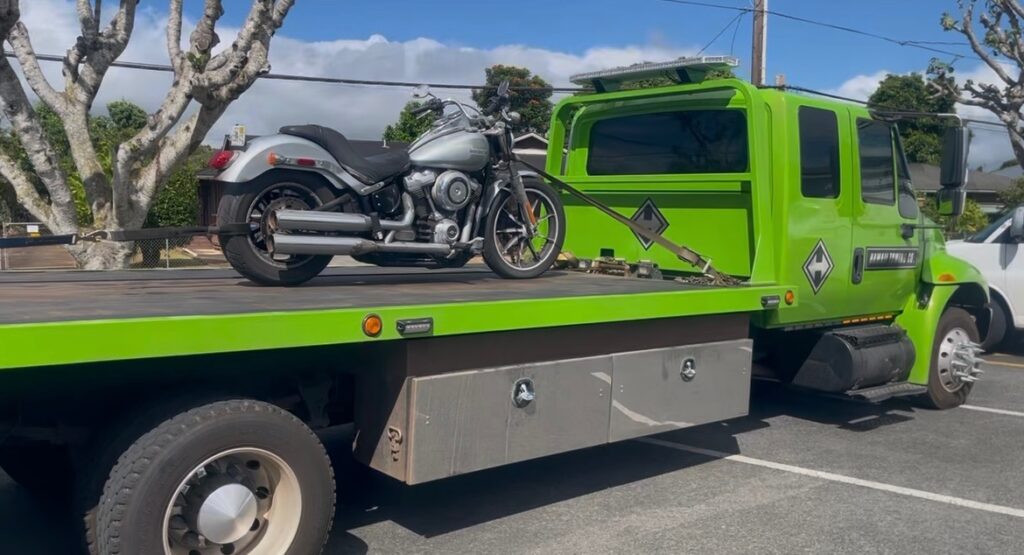
For motorcycle towing, our preferred method is simple: we use a flatbed tow truck.
A motorcycle needs to remain stable throughout transportation. Unlike a car, a bike cannot simply sit on four wheels while being transported.
Once the motorcycle is loaded onto our flatbed, we secure it using a three-point tie-down system. This helps keep the motorcycle upright while also limiting forward and backward movement during braking and transportation.
Before leaving, we inspect every strap and perform a stability test on the motorcycle.
We want to know that the bike is secure before the truck ever starts moving.
The Right Motorcycle Tie-Down Points Matter
One of the most common problems with motorcycle towing is using the wrong tie-down points.
Every motorcycle is different. Some bikes provide accessible frame points where straps can safely be attached. Others do not.
Our trucks carry the proper tie-down equipment for these situations. If suitable frame tie-down points are unavailable, we carry specialized straps designed to utilize the motorcycle’s handlebars.
The goal is not simply to put more straps on the motorcycle. The straps need to be placed correctly and work together to stabilize the bike.
Before transportation, we check:
- All straps and connections
- The motorcycle’s positioning on the flatbed
- Available frame or handlebar tie-down points
- Forward and backward movement
- Side-to-side stability
- Clearance around the motorcycle
- Overall stability before leaving
That final stability check is an important part of our process.
Lowered and Custom Motorcycles Can Require a Different Approach
We take precautions with every motorcycle, regardless of its make, model, or value. However, modified and lowered motorcycles sometimes require additional planning.
Some Harley-Davidson motorcycles, custom bikes, and lowered motorcycles have very little ground clearance. That becomes especially important while transitioning from the ground onto the flatbed.
If the loading angle is too steep, the rear of the motorcycle or a custom body kit can scrape.
In these situations, simply having a flatbed is not always enough. You also need to understand the motorcycle’s clearance and adjust the loading angle when necessary.
A Lowered Custom Motorcycle That Required an Extra Ramp
One motorcycle tow that stands out involved a custom bike with a body kit and lowered suspension.
The bike’s clearance created a problem before we even started loading it. With the normal approach angle, there was a risk that the rear of the motorcycle would scrape while transitioning onto the flatbed.
Instead of trying to force the bike up the bed, I used a specialized Styrofoam ramp designed to change the approach angle.
The additional ramp created a smoother transition onto the flatbed and provided the clearance we needed.
This is a good example of why experience matters with motorcycle towing.
Sometimes the challenge is not towing the motorcycle down the road. The difficult part is recognizing a potential problem before loading begins and having the right equipment available to solve it.
Accident-Damaged Motorcycles Require Additional Planning
Motorcycles involved in accidents can create completely different towing situations.
A damaged motorcycle may not roll normally. In more severe accidents, a motorcycle could even be missing a wheel.
Trying to handle these motorcycles the same way as an undamaged bike would not make sense.
When necessary, we can use the flatbed’s winch to bring an accident-damaged motorcycle onto the bed. Once loaded, the bike still needs to be properly positioned and secured to prevent additional movement during transportation.
Visible damage is one of the reasons we ask customers questions before dispatching a truck.
The more we know before arriving, the better we can prepare.
What We Need to Know Before Towing Your Motorcycle
When you call for motorcycle towing on Oahu, accurate information helps us determine what equipment the job will require.
We may ask for information such as:
- Motorcycle make and model
- Whether the motorcycle has been modified
- Whether the motorcycle is lowered
- Whether it was involved in an accident
- Whether both wheels are present
- Whether the wheels roll
- Visible damage
- Your exact pickup location
- Any unusual conditions around the motorcycle
These questions are not meant to make the process complicated. They help us make sure we arrive prepared and can actually perform the service safely.
Why Your Motorcycle’s Location Matters More Than You Might Think
One detail customers sometimes overlook is the motorcycle’s exact location.
For example, a customer may tell us where the motorcycle is located without mentioning that it is sitting on a steep hill.
That changes the situation.
A steep hill may require a longer winch-out. Before arriving, we need to consider the positioning of the flatbed and make sure our winch has enough length to perform the recovery properly.
Situations like this are rare, but they demonstrate why accurate information is imperative.
Something that seems like a small detail to the motorcycle owner can affect the equipment and preparation required for the tow.
If there is something unusual about where your motorcycle is sitting, tell your towing company before they arrive.
Questions to Ask Before Letting Someone Tow Your Motorcycle
Motorcycle owners should feel comfortable asking a towing company how their bike will be transported.
Before allowing someone to tow your motorcycle, consider asking:
- Are you bringing a flatbed?
- Do you have motorcycle-specific tie-down equipment?
- Do you carry equipment for lowered motorcycles?
- How will you secure my motorcycle?
- Can you handle the bike if it does not roll?
- Do you have a winch if the motorcycle cannot be loaded normally?
These questions become even more important if you own a larger, lowered, modified, custom, or accident-damaged motorcycle.
One of My Biggest Motorcycle Towing Red Flags
One of the biggest red flags for me is a towing company showing up for a larger motorcycle without a flatbed.
Equipment matters.
A tow operator should also understand how to position the motorcycle, identify appropriate tie-down points, secure the bike against movement, and adjust the loading approach when clearance is limited.
Having a tow truck does not automatically mean someone is properly equipped to transport every type of vehicle.
Motorcycles are a good example of that.
Motorcycle Towing Is About More Than Getting the Bike From A to B
When we tow a motorcycle, our responsibility begins before the bike moves.
We need to understand what we are picking up, where it is located, whether it has been modified, whether it rolls, and whether damage could affect the loading process.
From there, we can determine the safest way to get it onto the flatbed.
Once loaded, we use the appropriate tie-down points, secure the motorcycle with our three-point system, inspect the straps, and perform a stability test before transportation.
That process comes from more than 15 years of towing experience and understanding that no two towing situations are exactly alike.
Motorcycle Towing Across Oahu
Hawaii Towing Company provides motorcycle towing on Oahu for riders who need their bikes safely transported.
Whether you have a standard motorcycle, Harley-Davidson, lowered bike, custom build, or accident-damaged motorcycle, tell us as much as possible about the situation when you call.
The more accurate the information, the better we can prepare the proper equipment before arriving.
If your motorcycle needs to be towed, do not be afraid to ask how it will be transported and secured.
Your motorcycle deserves the right equipment, the right preparation, and a towing operator who understands how to safely get it onto the truck before the trip even begins.