

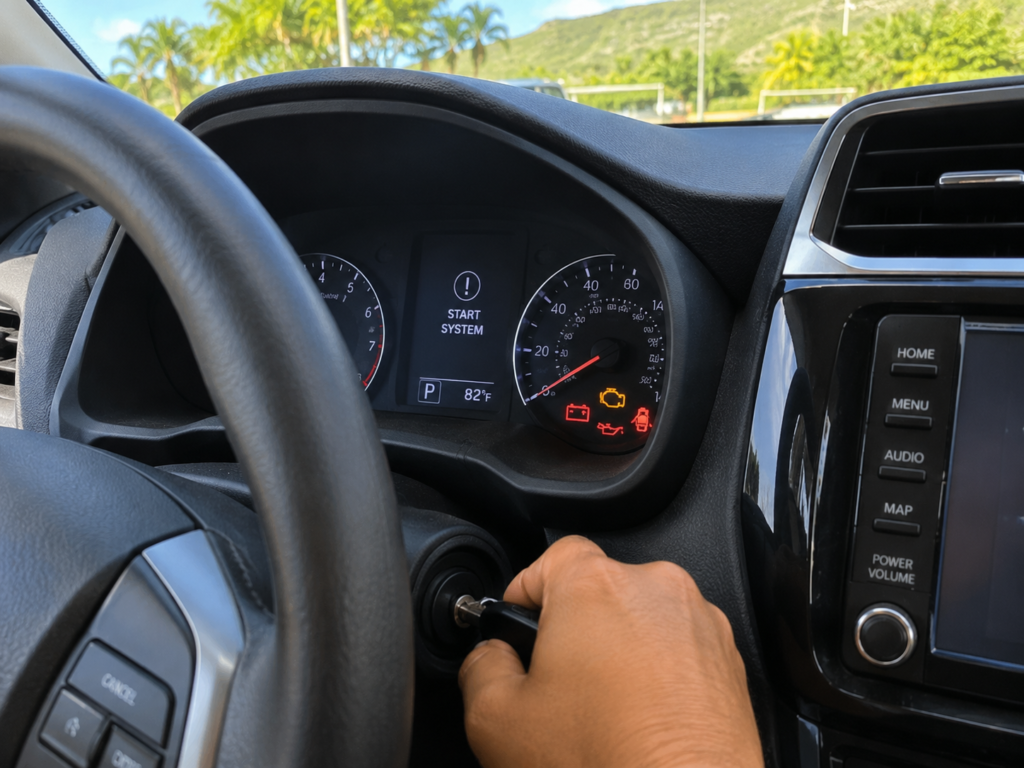
You get into your car, turn the key or press the start button, and nothing happens. However, your headlights, dashboard lights, and radio still work.
So, what’s wrong?
If your car won’t start but lights work, several problems could be responsible. It might be a weak battery, a faulty starter, a bad connection, or another electrical issue.
At Hawaii Towing Company, we’ve spent more than 15 years helping drivers across Oahu deal with unexpected vehicle problems.
One thing we’ve learned is that a car with working lights doesn’t necessarily have a healthy battery.
Before calling for help, there are a few things you should know.
Why Your Car Won’t Start but the Lights Still Work
Your vehicle needs considerably more electrical power to start its engine than it needs to operate its lights or radio.
Therefore, even if your headlights appear bright, your battery might not have enough power to turn the engine over.
However, a weak battery isn’t always the problem.
Here are some of the most common reasons your car won’t start.
1. Your Car Battery Might Be Weak
A weak or discharged battery is one of the first things to consider when your car won’t start but lights work.
Your headlights, dashboard, and radio require relatively little electrical power compared to the starter motor.
As a result, these accessories might operate normally even when your battery cannot start the engine.
Common signs of a weak battery include:
- Rapid clicking when turning the key
- Dashboard lights dimming during a starting attempt
- Slow engine cranking
- Intermittent starting problems
- A vehicle that starts after receiving a jump-start
However, these symptoms don’t automatically mean your battery needs replacement.
Loose battery connections, charging problems, and other electrical issues can produce similar symptoms.
Can a Jump-Start Fix the Problem?
Sometimes, yes.
If the battery is simply discharged, a properly performed jump-start may get your vehicle running again.
However, it’s important to identify why the battery lost its charge.
At Hawaii Towing Company, we recommend allowing the vehicle to run for approximately 3–5 minutes after a successful jump-start while checking for obvious signs of charging problems.
This brief observation can help identify immediate issues, but it does not confirm that the alternator or battery is healthy.
We also recommend having your battery and charging system professionally tested.
If you need assistance, visit our 24-hour roadside assistance page.
2. Your Starter Motor Could Be Failing
Another possible reason your car won’t start is a faulty starter motor.
The starter is responsible for turning your engine over when you attempt to start the vehicle.
When it fails, your vehicle may have electrical power but still refuse to start.
Common signs of starter problems include:
- A single clicking sound when attempting to start
- Dashboard lights working normally
- No engine cranking
- Intermittent starting problems
- A starter that operates inconsistently
However, these symptoms can also indicate a weak battery or poor electrical connection.
Therefore, proper diagnosis is important before replacing any parts.
If your starter has failed, a jump-start usually won’t solve the problem.
In that situation, professional towing may be necessary.
3. Loose or Corroded Battery Connections
Sometimes, the battery itself isn’t the problem.
Instead, the issue may involve loose, dirty, or corroded battery terminals.
Your vehicle depends on secure electrical connections to deliver power to the starter.
Even a relatively small amount of resistance at a connection can interfere with starting.
Signs of connection problems include:
- White or greenish buildup around battery terminals
- Intermittent electrical power
- Clicking when attempting to start
- Lights that dim or flicker
- A vehicle that starts inconsistently
If you notice visible corrosion, avoid touching or attempting to clean the terminals unless you know how to do so safely.
Battery acid and electrical shorts can cause injuries.
A qualified technician can inspect the connections and determine whether cleaning, tightening, or replacement is necessary.
4. Your Alternator May Not Be Charging the Battery
Your alternator helps supply electrical power while the engine is running.
It also recharges the battery after the engine starts.
However, when the alternator begins failing, your battery may gradually lose its charge.
Eventually, your car might not start even though some electrical accessories still work.
Possible signs of alternator trouble include:
- A battery warning light while driving
- Headlights that dim or flicker
- Repeated dead batteries
- Electrical accessories behaving unusually
- A vehicle that stalls after starting
Keep in mind that the alternator doesn’t directly crank the engine.
Instead, a failing alternator can leave the battery too weak to start your vehicle.
If the charging system isn’t working properly, a jump-start may only provide a temporary solution.
In that case, towing the vehicle to a repair shop may be safer than attempting to drive it.
5. Your Vehicle Might Not Recognize Park or Neutral
Sometimes, the problem has nothing to do with the battery or starter.
Many automatic vehicles use a park/neutral safety system that prevents the engine from cranking unless the transmission is in Park or Neutral.
If the system isn’t recognizing the correct gear position, your vehicle might refuse to start.
If you’re safely parked, apply the parking brake, keep your foot firmly on the brake pedal, and verify that the transmission is in Park.
You can also consult your owner’s manual to determine whether your vehicle supports starting in Neutral.
However, never attempt to bypass a safety switch.
If the vehicle still refuses to start, professional diagnosis may be necessary.
6. A Faulty Key Fob or Immobilizer Could Be Responsible
Modern vehicles rely on electronic security systems to recognize authorized keys.
If your vehicle cannot detect the key fob, it may prevent the engine from starting.
In some cases, the dashboard lights and accessories will continue working normally.
Possible warning signs include:
- A key-not-detected message
- An immobilizer warning light
- A start button that doesn’t respond
- Intermittent key recognition
If you suspect a key fob problem, consult your owner’s manual.
Some vehicles allow emergency starting using a specific key fob location or backup procedure.
However, the correct method depends on your vehicle’s make and model.
When You Should Avoid Jump-Starting Your Car
Not every no-start situation should be handled with a jump-start.
During our years of providing roadside assistance on Oahu, we’ve learned that recognizing potential electrical hazards is just as important as getting a vehicle running.
For example, if you notice a burning plastic smell, smoke, damaged wiring, or signs of an electrical short, do not attempt to jump-start the vehicle.
Doing so could make the situation worse.
Instead, stop attempting to start the engine and arrange for professional assistance.
If the vehicle is smoking or showing signs of fire, move away to a safe location and contact emergency services.
Sometimes, the safest decision is to tow the vehicle rather than attempt to start it.
What Should You Do Before Calling a Tow Truck?
If your car won’t start but lights work, there are a few simple steps you can take.
First, make sure you’re in a safe location.
If your vehicle is parked on the shoulder of a busy road or freeway, prioritize your safety over troubleshooting.
Next, pay attention to what happens when you attempt to start the vehicle.
Does the engine crank slowly? Do you hear clicking? Or does absolutely nothing happen?
These details can help a roadside assistance provider understand the situation.
You should also check your dashboard for warning messages.
Finally, avoid repeatedly attempting to start the engine if the vehicle isn’t responding.
Repeated attempts can further drain the battery or place additional stress on electrical components.
When Is Towing Better Than a Jump-Start?
A jump-start can be useful when a battery is simply discharged.
However, it isn’t the right solution for every starting problem.
Professional towing may be the better option when:
- The starter motor has failed.
- The alternator isn’t charging properly.
- The vehicle has an electrical short.
- The vehicle won’t crank after appropriate troubleshooting.
- The transmission or electronic shifter is malfunctioning.
- The vehicle cannot be operated safely.
At Hawaii Towing Company, we provide professional vehicle towing services for drivers throughout Oahu.
We also offer flatbed towing services for vehicles that require additional care during transportation.
Our goal is to help you get your vehicle to the appropriate repair facility without creating additional problems.
Why Experience Matters When Your Car Won’t Start
When your vehicle refuses to start, the last thing you need is unnecessary confusion.
At Hawaii Towing Company, we believe good roadside assistance starts with asking the right questions.
Before arriving, we want to understand your vehicle, its symptoms, your location, and whether you’re in a safe situation.
This helps us determine what equipment and assistance may be needed.
With more than 15 years of towing experience, we’ve encountered many different vehicle problems.
We understand that every situation is different.
That’s why we emphasize clear communication, accurate ETAs, upfront pricing, and treating customers with the same care we would give our own family.
Our philosophy is simple:
“You shouldn’t feel like an inconvenience in an inconvenient situation.”
We’re also proud to have been recognized among Honolulu’s top towing companies by ThreeBestRated.
24/7 Towing and Roadside Assistance Across Oahu
Whether your battery is dead, your starter has failed, or your vehicle has an electrical problem, Hawaii Towing Company is here to help.
We provide 24-hour towing and roadside assistance throughout Oahu, including:
Whether you’re stranded at home, in a shopping center parking lot, or along the highway, we’re ready to assist.
Car Won’t Start but Lights Work? Call Hawaii Towing Company
If your car won’t start but lights work, don’t automatically assume the battery is the problem.
A weak battery, faulty starter, bad connection, charging-system failure, or electronic issue could be responsible.
Understanding the warning signs can help you make a better decision about what to do next.
However, if you’re unsure what’s wrong, professional assistance is often the safest option.
At Hawaii Towing Company, we combine more than 15 years of experience with professional equipment, honest communication, and a commitment to treating every customer with respect.
Need help getting your vehicle started or safely transported?
Visit Hawaii Towing Company or contact us today for reliable 24/7 towing and roadside assistance on Oahu.
Let our experience make your inconvenient situation a little easier.