

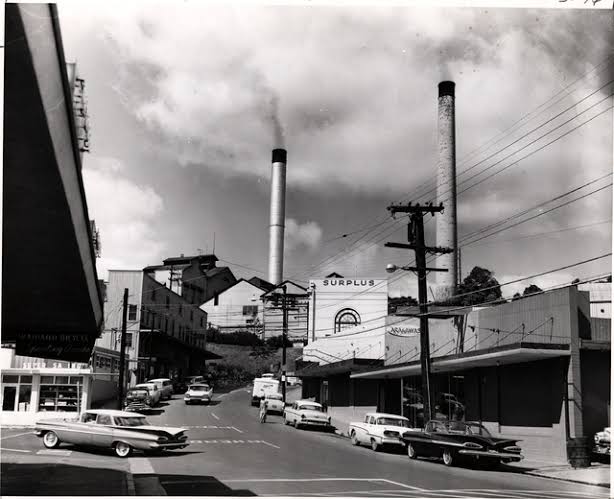
When people search for the history of Waipahu, they will find stories about sugar plantations, immigrant workers, old buildings, and the Oahu Sugar Company.
Those things are an important part of Waipahu’s history. But if you grew up here, you know there is another side of the story.
Waipahu’s history lives in the food we eat, the businesses we remember, the backroads we still drive, and the way generations of families have looked after one another.
Hawaii Towing Company has been in Waipahu for more than 15 years, but our connection to this town goes back much further.
This is the Waipahu we remember.
Waipahu and the Sugar Plantation Era
To understand Waipahu, you have to understand sugar.
The Oahu Sugar Company built its Waipahu mill in 1898, and the mill remained an important part of the community until sugar operations ended in 1995. At one point, the mill was one of the area’s largest employers.
One piece of that history is still impossible to miss.
The approximately 170-foot sugar mill smokestack remains a Waipahu landmark. Around here, many of us know it by a much less formal name:
The Big Cigarette.
You can see that smokestack and immediately know you’re in Waipahu.
But the plantation’s impact went much deeper than a mill or a smokestack.
Where Waipahu’s Melting Pot Took Shape
Plantation life brought together people from many different cultures.
Hawaiian, Chinese, Japanese, Filipino, Korean, Okinawan, Portuguese, Puerto Rican, and other communities lived and worked alongside one another.
Those cultures didn’t disappear when the plantation era ended.
They became part of Waipahu.
Today, you can experience some of that history at Hawaii’s Plantation Village in Waipahu. The outdoor museum preserves and recreates plantation homes and community structures while telling the stories of the different cultural groups that shaped plantation life in Hawaii.
For us, that mixture of cultures is one of the things that still defines Waipahu.
You see it in our families.
You hear it in the way people talk.
And you definitely taste it in our food.
Growing Up in Waipahu Meant Having Places You Never Forgot
Ask longtime Waipahu residents about the old days and eventually someone will start naming stores.
For us, one of those places was Arakawa’s.
Walking through Arakawa’s as a kid was an experience. It felt almost like an indoor swap meet, filled with knickknacks, food, snacks, and all kinds of things to discover.
For a child, it was a delight.
There was Big Way Supermarket. There was GEMs, which later became Daiei and eventually Don Quijote before that location closed.
We remember Woolworth, Pay ‘n Save and Payless ShoeSource.
And then there was CJ Kitty.
For a kid who loved Sanrio, that place was a dream.
These businesses may sound like nothing more than store names to someone who didn’t grow up here. But to many Waipahu families, they represent childhood.
They’re where our parents took us.
They’re where we ran into neighbors.
They’re part of the places we remember when we think about growing up in Waipahu.
The buildings and businesses may change, but we keep those memories with us.
Some Waipahu Favorites Are Still Going Strong
Thankfully, not everything disappeared.
Some longtime Waipahu establishments are still serving the community generations later.
Rocky’s Coffee Shop opened on Waipahu Depot Road in 1959. More than 60 years later, people still know Rocky’s for old-school local breakfasts, including its fried rice and omelets.
For us, it’s hard to think about Rocky’s without thinking about the fried rice omelet, coffee and those buttery short stacks.
Then there’s Tanioka’s.
Mel and Lynn Tanioka started the business in 1978. What began as a single retail stall grew into one of Waipahu’s best-known local seafood businesses.
People come for the fresh poke, but longtime customers know there’s much more—fish patty musubis, Spam musubis, okazuya favorites and plenty of other local food.
And, of course, there is Leeward Drive-Inn.
Serving Waipahu since 1964, it remains one of those places that connects generations through food.
Their famous fried noodles still bring comfort to longtime Waipahu residents today.
That’s part of Waipahu history too.
History doesn’t always have to be displayed behind glass in a museum. Sometimes you can order it at the counter.
You Can Still Feel Old Waipahu When You Drive Through Town
Waipahu has changed.
There are newer developments, different businesses and much more traffic. The freeway changed how people move through the community, and modern development surrounds much of old Waipahu.
Yet there are times when it still feels remarkably familiar.
Farrington Highway remains one of the main roads through town.
Then there are what locals simply call the backroads.
If you know Waipahu, you know there are different ways to cut through town, take S Road toward Waikele, or work your way back toward the freeway.
After spending enough years here, you don’t always think about the street names.
You just know where the road goes.
That’s another little part of being from Waipahu that doesn’t show up on a map.
What Makes Waipahu Different?
For us, Waipahu has always been a working-class town.
People worked hard.
Families stayed here for generations.
Cultures mixed together.
Small businesses became community institutions.
Food became one of the ways those cultures were shared.
But perhaps the most important part was how people treated one another.
Growing up here, helping somebody wasn’t necessarily something you thought twice about.
If someone needed help, you helped.
Your neighbors weren’t just the people who happened to live next door.
They were part of your community.
In a way, your neighborhood was your kuleana—your responsibility.
We didn’t necessarily realize we were learning those values at the time.
Looking back, we were.
A Towing Call That Brought Me Back to My Childhood
Years later, one ordinary towing call reminded me just how deeply those lessons stayed with us.
I was called to Waipahu for a vehicle that had overheated.
It seemed like a typical day.
I arrived, introduced myself and started hooking up the customer’s vehicle. The man looked somewhat familiar, but I couldn’t figure out why.
He ended up riding with me while I towed his car to his home.
While we were driving, he asked my name.
Then he said something along the lines of, “I knew it. You’re the guy who helped me once.”
I was confused.
Then he explained.
We had lived on the same street when we were kids.
One day, he had broken his arm. I saw that he was hurt, put him on my bicycle and took him home.
I barely remembered doing it.
He never forgot it.
He told me that moment had stayed with him throughout his life.
Hearing that hit me harder than I expected.
Of course, I was proud that something I had done as a kid had positively affected another person.
But it also brought me right back to growing up in Waipahu.
As children, we didn’t use words like community values to describe what we were doing.
We just helped.
If your friend was hurt, you took him home.
If your neighbor needed something, you helped your neighbor.
You didn’t stop first and ask what you were going to get out of it.
Decades later, there we were again.
The same two kids from a Waipahu neighborhood were now adults sitting together in a tow truck because, once again, one of us needed a little help getting where he needed to go.
Waipahu’s History Is Still Being Written
The sugar mill eventually closed.
Many of the stores we grew up visiting are gone.
Neighborhoods expanded. Businesses changed. Roads became busier.
But Waipahu never completely lost what made it Waipahu.
You can see the old sugar mill smokestack.
You can visit Hawaii’s Plantation Village and learn about the cultures that came together during Hawaii’s plantation era.
You can eat breakfast at Rocky’s, grab poke from Tanioka’s or order fried noodles from Leeward Drive-Inn.
And if you’ve been here long enough, you can drive down certain streets and remember exactly what used to be there.
That’s the history of Waipahu we want people to understand.
It isn’t only a story about sugar.
It’s a story about immigration, hard work, food, family, local businesses and generations of people from different backgrounds learning to live together.
Most of all, it’s about community.
After more than 15 years of providing towing services in Waipahu, and a lifetime of memories connected to this town, we’re proud that Waipahu is part of the Hawaii Towing Company story.
Businesses will come and go. Buildings will change. Another generation will grow up here and create its own memories.
But hopefully one thing never changes:
When somebody in your community needs help, you help them.
Because your neighborhood is your kuleana.