

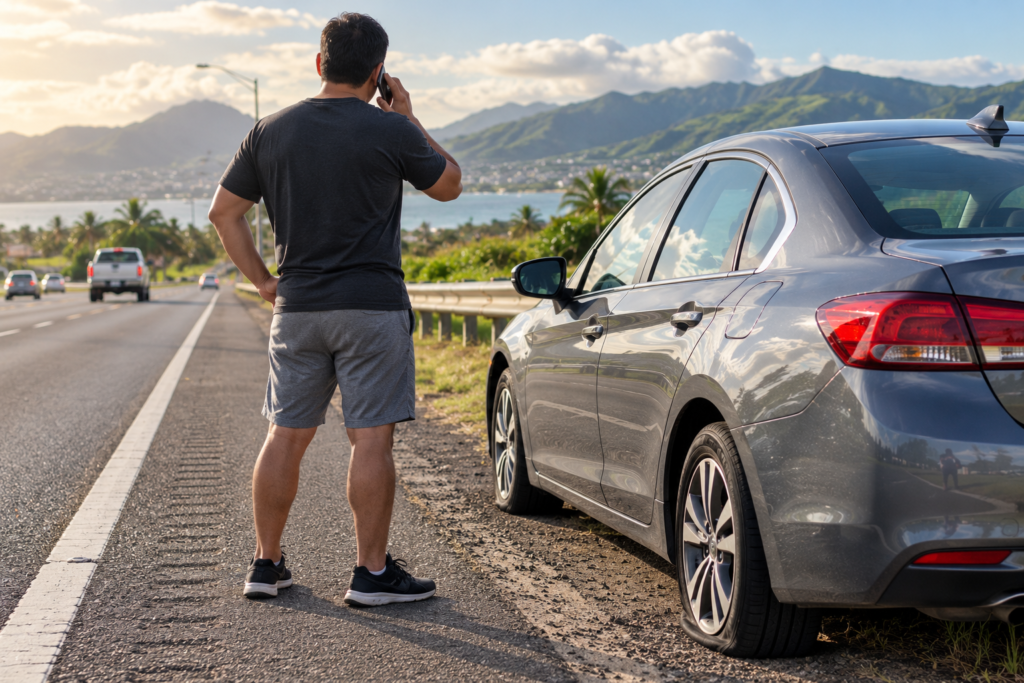
When your vehicle breaks down, knowing what to expect from a towing company can make a stressful situation much easier.
Whether you have a flat tire, a dead battery, an overheating engine, or an accident, finding reliable towing services on Oahu is important.
But what actually happens when you call a towing company?
At Hawaii Towing Company, we believe professional towing starts long before a tow truck arrives.
With over 15 years of towing experience on Oahu, we’ve learned that asking the right questions, providing accurate information, and communicating clearly can make all the difference.
Our goal is simple: Make your towing experience as safe, straightforward, and stress-free as possible.
Here’s what you can expect when you call Hawaii Towing Company.
Step 1: We Answer Your Call and Find Out What Happened
Every towing situation is different.
Some customers call because their vehicle won’t start. Others need assistance after an accident or require transportation for a specialty vehicle.
Before dispatching a tow truck, we take the time to understand your situation.
We typically ask questions such as:
- What is the year, make, and model of your vehicle?
- Where is your vehicle currently located?
- What happened to your vehicle?
- Can your vehicle shift into neutral?
- Is your vehicle all-wheel drive, front-wheel drive, or rear-wheel drive?
- Does your vehicle have any modifications or low ground clearance?
- Are there any damaged or missing wheels?
- Where would you like your vehicle transported?
- Will you need a ride, and how many passengers are with you?
- Are you currently in a safe location?
These questions might seem excessive for a simple tow.
However, they help us determine which equipment and towing method your vehicle requires.
The more information we have before arriving, the better prepared we can be.
For example, a vehicle that cannot shift into neutral may require different equipment than one that rolls freely.
Likewise, a lowered sports car may need additional ramps to prevent damage during loading.
Taking a few extra minutes during the initial conversation can help prevent unnecessary complications later.
Step 2: Your Safety Comes First
Before discussing the towing process, we want to know whether you’re safe.
Breaking down on a busy highway is different from experiencing a dead battery in your driveway.
If you’re stranded along H-1, H-2, or another busy road on Oahu, your safety should always be the priority.
We recommend:
- Moving your vehicle to a safe location when possible.
- Turning on your hazard lights.
- Staying away from moving traffic.
- Avoiding unnecessary roadside repairs in dangerous locations.
- Calling emergency services if anyone is injured or immediate danger exists.
When we arrive, we assess the surroundings before beginning the towing process.
We consider traffic, vehicle positioning, road conditions, and other potential hazards.
Your safety matters more than how quickly we can hook up your vehicle.
Step 3: We Provide Upfront Pricing Before Dispatch
One of the biggest concerns customers have when calling a towing company is pricing.
Nobody wants to receive one price over the phone and discover unexpected charges after their vehicle has been loaded.
At Hawaii Towing Company, we believe in honest communication and upfront pricing.
After discussing your vehicle, location, and towing requirements, we provide a quote based on the information available.
Our quoted price covers the agreed towing service, excluding applicable taxes and credit card processing fees.
We explain those additional charges so customers understand what to expect.
What Happens If the Towing Price Needs to Change?
Occasionally, we arrive and discover something that wasn’t mentioned during the initial conversation.
For example, a customer may request towing for a standard vehicle. However, when we arrive, we discover that the vehicle has extremely low ground clearance and an aftermarket body kit.
This may require additional equipment or preparation.
If the situation changes the original quote, we explain the difference before hooking up the vehicle.
The customer can then decide whether to proceed.
If they decline the revised quote before hookup, we do not charge them.
We believe customers deserve the opportunity to make informed decisions without feeling pressured.
Additionally, we don’t believe every small adjustment deserves an additional service charge.
Sometimes, helping a customer simply means doing what’s reasonable.
Step 4: We Provide an Accurate Estimated Arrival Time
When you’re stranded, waiting for a tow truck can feel like forever.
That’s why we make an effort to provide realistic estimated arrival times.
Rather than promising an arrival time we cannot meet, we consider several factors before providing an ETA.
These include:
- Your current location.
- Traffic conditions.
- The location of our available tow trucks.
- The type of equipment your vehicle requires.
- Current towing demand.
- Road conditions and accessibility.
Traffic on Oahu can change quickly, especially during morning and afternoon rush hours.
Areas such as Waipahu, Ewa Beach, Kapolei, Pearl City, and Honolulu can experience significant congestion.
Although unexpected delays can happen, our goal is to provide accurate estimates and communicate clearly.
We would rather give you a realistic arrival time than make an unrealistic promise.
Step 5: Our Tow Truck Arrives and We Inspect Your Vehicle
Once our operator arrives, we don’t immediately begin loading your vehicle.
First, we evaluate the situation.
This includes checking the vehicle’s condition, positioning, and any potential complications.
Depending on the vehicle, we may inspect:
- Ground clearance.
- Front and rear bumpers.
- Tires and wheels.
- Suspension components.
- Drivetrain configuration.
- Available towing and recovery points.
- Existing accident damage.
- Aftermarket modifications.
These inspections help us choose an appropriate loading method.
Why This Matters for Specialty Vehicles
Over the years, we’ve transported everything from everyday passenger vehicles to luxury cars, motorcycles, electric vehicles, and heavily modified vehicles.
One memorable example involved a heavily lowered Acura NSX with an aftermarket body kit.
The vehicle sat so low that even our modified loading ramp couldn’t fit beneath the front bumper.
Instead of forcing the vehicle onto the flatbed, we used an additional starter ramp.
We then loaded the vehicle slowly while constantly monitoring its clearance.
What appeared to be a simple tow required patience, preparation, and careful attention.
Experiences like this have taught us an important lesson.
Not every vehicle should be towed the same way.
Learn more about our Special Vehicle Towing Services.
Step 6: We Choose the Appropriate Towing Equipment
After inspecting your vehicle, we determine the appropriate towing method.
At Hawaii Towing Company, we use professional towing equipment designed to accommodate different vehicles and situations.
Flatbed Towing
Flatbed towing is often our preferred method for transporting vehicles that require additional protection.
With all four wheels off the ground, a flatbed can help prevent unnecessary tire wear and drivetrain damage.
Flatbeds are especially useful for:
- Luxury and exotic vehicles.
- Electric vehicles.
- All-wheel-drive vehicles.
- Lowered and modified cars.
- Motorcycles.
- Vehicles with accident damage.
Learn more about our Flatbed Towing Services on Oahu.
Wheel-Lift Towing
Not every vehicle requires a flatbed.
Depending on the vehicle’s condition and manufacturer requirements, wheel-lift towing may be appropriate.
For example, certain vehicles that cannot shift into neutral or are located in tight parking areas may require a wheel-lift approach.
However, the vehicle’s drivetrain, ground clearance, and overall condition must be considered.
We won’t recommend a flatbed simply because it costs more.
Our goal is to choose the appropriate equipment for your situation.
Step 7: We Carefully Load and Secure Your Vehicle
Loading a vehicle onto a tow truck involves more than simply attaching a winch cable.
Proper loading requires experience, suitable attachment points, and attention to vehicle positioning.
Before loading, we consider the vehicle’s condition and any components that could be damaged.
For lowered vehicles, we pay particular attention to bumpers, side skirts, exhaust systems, and undercarriage clearance.
For electric vehicles, we follow the applicable manufacturer towing procedures.
Many electric vehicles require flatbed transportation to keep all four wheels off the ground.
Some also require Transport Mode before loading.
Our Experience With Electric Vehicles
We’ve encountered situations where an electric vehicle’s low-voltage battery prevented it from entering Transport Mode.
In one Tesla towing situation, we used a jump pack to provide the low-voltage power needed to enable Transport Mode.
Once the vehicle was ready, we loaded it onto our flatbed.
Knowing how to handle situations like this helps us avoid unnecessary complications.
After loading, we secure the vehicle using suitable straps and attachment points.
Before leaving, we check the vehicle’s positioning and securement.
We treat every vehicle as if it were our own.
Step 8: We Transport Your Vehicle to Its Destination
Once your vehicle is properly secured, we’re ready to transport it.
Some customers need their vehicles delivered to a repair shop.
Others request transportation to their homes, dealerships, body shops, or another location.
We confirm the destination before beginning transportation.
During the trip, our operators drive with the vehicle’s safety and security in mind.
Can You Ride Along With the Tow Truck?
This is one of the questions customers frequently ask.
At Hawaii Towing Company, we allow customers to ride along when it is safe and an appropriate seat with a seatbelt is available.
However, passenger capacity depends on the tow truck and the situation.
That’s why we ask about passengers during the initial phone conversation.
We want to make sure everyone has a safe transportation plan before we arrive.
Step 9: We Safely Unload Your Vehicle
Our job doesn’t end when we reach your destination.
We still need to unload your vehicle safely.
Before unloading, we assess the surrounding area and determine where the vehicle should be placed.
We consider available space, ground conditions, clearance, and vehicle accessibility.
For specialty vehicles, unloading can require the same attention as loading.
We carefully remove the securement equipment and position the vehicle at the agreed destination.
Our goal is to complete the service professionally from beginning to end.
Step 10: We Make Sure You Understand the Final Charges
After completing the towing service, we explain the final charges.
We believe customers should understand what they’re paying for.
Our goal is to provide a straightforward experience without unnecessary surprises.
From the initial phone call to the final delivery, we focus on honest communication and professional service.
That’s how we believe towing should be done.
What If You Don’t Actually Need a Tow?
Not every roadside emergency requires towing.
Sometimes, a customer simply needs roadside assistance.
For example, a dead battery may only require a jump-start.
However, we also understand that certain situations require additional caution.
If we suspect an electrical short, such as a burning plastic smell or signs of smoke, we won’t attempt a jump-start.
Instead, we recommend towing the vehicle for further inspection.
Our goal is to identify the safest and most appropriate solution.
Learn more about our 24/7 Roadside Assistance Services.
Why Experience Matters When Choosing a Towing Company
With more than 15 years of towing experience on Oahu, we’ve learned that successful towing involves much more than operating a truck.
It requires understanding different vehicles, communicating with customers, and making responsible decisions.
Some towing situations are straightforward.
Others require special equipment, additional preparation, or a different approach.
The important thing is knowing the difference.
At Hawaii Towing Company, we focus on:
- Professional and experienced towing operators.
- Honest, upfront pricing.
- Accurate estimated arrival times.
- Proper towing equipment.
- Careful vehicle loading and securement.
- Clear communication.
- Customer safety and satisfaction.
We’re also proud to have been recognized among the Top 3 Towing Companies in Honolulu by ThreeBestRated.
This recognition reflects the level of service we work hard to provide our customers.
Proudly Providing 24/7 Towing Services Across Oahu
Whether you need emergency towing in the middle of the night or scheduled vehicle transportation during the day, Hawaii Towing Company is available 24 hours a day, seven days a week.
We proudly serve communities throughout Oahu, including:
- Waipahu Towing Services
- Ewa Beach Towing Services
- Kapolei Towing Services
- Pearl City Towing Services
- Mililani Towing Services
- Wahiawa and surrounding communities
- Honolulu Towing Services
From everyday vehicle towing to specialty transportation, we’re committed to providing dependable service throughout the island.
Frequently Asked Questions About Calling Hawaii Towing Company
How Much Does Towing Cost on Oahu?
Towing prices depend on several factors, including your vehicle, location, destination, and required equipment.
We provide upfront quotes after discussing your situation.
How Long Does It Take for a Tow Truck to Arrive?
Arrival times depend on traffic, location, truck availability, and service requirements.
We strive to provide accurate estimated arrival times rather than unrealistic promises.
Do You Offer 24-Hour Emergency Towing?
Yes. Hawaii Towing Company provides 24/7 towing and roadside assistance throughout Oahu.
Can You Tow Electric Vehicles and Teslas?
Yes. We have experience transporting electric vehicles, including Teslas.
We use appropriate flatbed equipment and follow applicable vehicle-specific towing procedures.
Can You Tow Lowered or Modified Vehicles?
Yes. We have experience towing lowered vehicles, modified cars, luxury vehicles, and specialty automobiles.
Additional loading equipment may be necessary depending on the vehicle’s clearance and modifications.
Can I Ride in the Tow Truck?
Yes, when conditions allow and an appropriate seat with a seatbelt is available.
Please let us know how many passengers need transportation when you call.
Need a Tow? Experience the Difference With Hawaii Towing Company
Vehicle breakdowns and roadside emergencies are never convenient.
However, choosing the right towing company can make the experience much easier.
At Hawaii Towing Company, we believe every customer deserves honest pricing, professional service, clear communication, and careful vehicle handling.
For more than 15 years, we’ve helped drivers throughout Oahu with everyday towing needs and challenging transportation situations.
Whether you’re stranded on H-1, dealing with a dead battery in Kapolei, or need specialty vehicle towing in Honolulu, we’re here to help.
We treat every vehicle as if it were our own, and every customer with the respect they deserve.
🚛 Need professional towing services on Oahu?
📞 Call Hawaii Towing Company at 808-672-7711.
We’re available 24 hours a day, 7 days a week.
Visit our homepage to explore our services, or contact Hawaii Towing Company for assistance.
Hawaii Towing Company — Experience the Difference!