

If you need a tow, you may wonder about flatbed towing vs wheel-lift towing and which is the better choice for your vehicle.
After more than 15 years in the towing industry, we can tell you there isn’t one answer that applies to every vehicle.
At Hawaii Towing Company, we use both flatbed and wheel-lift tow trucks. In our experience, neither method is automatically better than the other. The right choice depends on your vehicle, its condition, its location, and the circumstances surrounding the tow.
We believe customers deserve an honest recommendation. If your vehicle doesn’t need a flatbed, we’re not going to push you into a flatbed service just because it may cost more.
Our priority is choosing the towing method that allows us to safely and efficiently transport your vehicle.
What Is the Difference Between Flatbed and Wheel-Lift Towing?
The biggest difference comes down to how your vehicle is transported.
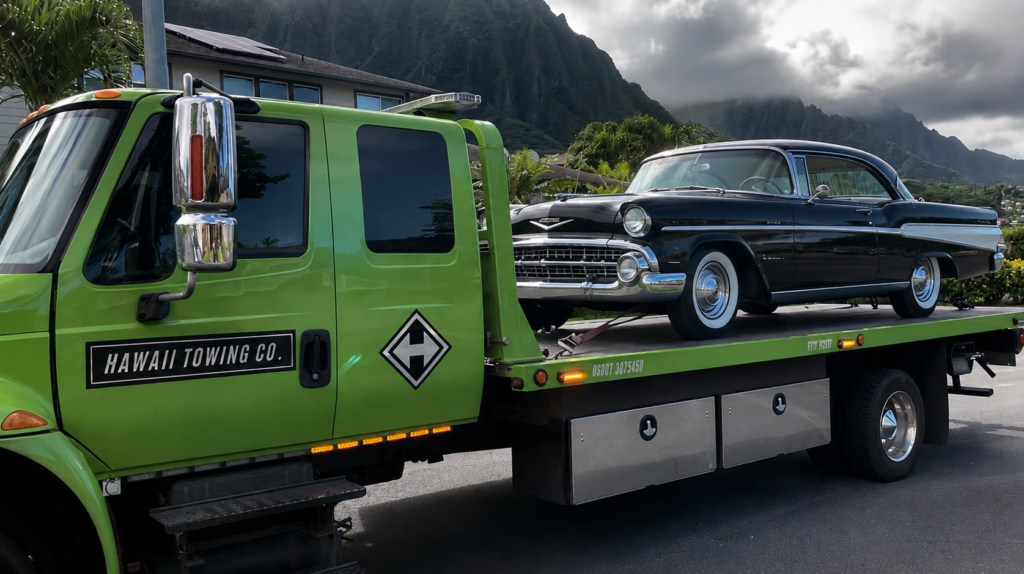
A flatbed tow truck loads the entire vehicle onto the truck’s bed. All four wheels remain off the road during transportation.
A wheel-lift tow truck uses a metal yoke or grid that goes underneath the vehicle’s tires. One end of the vehicle is lifted while the other wheels may remain on the road during the tow.
Both methods can be safe when they are used for the right vehicle and operated by an experienced towing professional.
The important question isn’t simply, “Which tow truck is better?”
The better question is:
Which towing method is right for this particular vehicle and situation?
When Should You Use a Flatbed Tow Truck?
There are certain situations where we strongly prefer using a flatbed.
Based on our experience towing vehicles throughout Oahu, we commonly recommend flatbed towing for:
- Lowered vehicles
- Modified vehicles
- All-wheel-drive vehicles
- Four-wheel-drive vehicles
- Lifted trucks
- Trucks with oversized tires
- Luxury and exotic vehicles
- Classic vehicles
- Vehicles with significant physical damage
- Vehicles with damaged or loose components
- Vehicles with flat tires
- Vehicles with limited ground clearance
The major advantage of a flatbed is that the entire vehicle can be transported with its wheels off the roadway.
That becomes especially important when we’re dealing with vehicles that have mechanical damage, modifications, drivetrain considerations, or very little ground clearance.
Why We Often Recommend Flatbeds for Lowered and Modified Vehicles
Lowered and modified vehicles require extra attention.
The clearance underneath the vehicle may be much smaller than it appears. Using the wrong equipment or approaching the vehicle incorrectly can potentially damage components underneath the car.
We’ve seen firsthand what can happen.
One customer had a lowered vehicle towed by an inexperienced operator. The vehicle sat too low for the towing method being used, and the oil pan was damaged.
In our opinion, that vehicle should have been transported on a flatbed.
Situations like this are why an experienced tow operator should evaluate more than whether a truck can physically hook up to a vehicle.
We also have to consider whether we can do it without damaging the vehicle’s undercarriage, oil pan, body, or other components.
Why AWD and 4WD Vehicles Require Special Attention
All-wheel-drive and four-wheel-drive vehicles can require additional precautions because of how their drivetrains operate.
One experience from our years in the towing business stands out.
A customer had an all-wheel-drive vehicle picked up by another towing company using a wheel lift. The vehicle was put into neutral and towed incorrectly.
The transmission was damaged.
The customer eventually called Hawaii Towing Company to have us tow the damaged vehicle again—this time to an auto repair shop.
Unfortunately, by that point, the damage had already been done.
This is why telling your towing company that your vehicle is AWD or 4WD is extremely important. The tow operator needs that information before deciding how the vehicle should be transported.
Simply putting a vehicle into neutral doesn’t automatically mean it can safely be towed with wheels on the ground.
When Is Wheel-Lift Towing the Better Choice?
Wheel-lift towing sometimes gets treated as though it is automatically inferior to flatbed towing.
We disagree.
After more than 15 years in this business, our experience has taught us that wheel-lift towing can be perfectly safe when the right equipment is used by an experienced operator.
In fact, there are situations where we may prefer a wheel lift.
Parking Garages and Tight Spaces
Parking garages are a good example.
A flatbed tow truck requires enough room to position the truck and operate the bed. Height restrictions and limited maneuvering space can also create problems.
Wheel-lift trucks can be much more practical in compact areas.
We may prefer a wheel lift for:
- Parking garages
- Tight parking areas
- Areas with limited maneuvering room
- Vehicles positioned where a flatbed cannot safely operate
The goal is always to match the equipment to the situation.
When the Keys Aren’t Available
Another situation involves vehicles where the keys aren’t available or the vehicle cannot be shifted into neutral.
Depending on the vehicle and its position, a wheel lift may provide an effective way to move or recover it.
Again, the operator needs to understand the vehicle before attempting the tow.
Is Wheel-Lift Towing Safe?
Yes. When used correctly, wheel-lift towing can be very safe.
The problem isn’t necessarily the wheel lift itself.
Problems happen when the wrong equipment is used for the vehicle or the operator doesn’t account for clearance, drivetrain configuration, tire size, modifications, or existing damage.
Before using a wheel lift, an experienced operator should consider whether:
- The tires properly fit the wheel-lift grid
- The equipment can safely get underneath the vehicle
- There is enough ground clearance
- The undercarriage will remain protected
- The oil pan and other components are clear
- The drivetrain allows the vehicle to be transported that way
- The vehicle has modifications that affect towing
- Existing damage could become worse during transport
When those factors are properly evaluated, a wheel lift can be an excellent towing option.
One of the Biggest Towing Problems Starts Before the Truck Arrives
You might expect us to say that inexperienced tow operators cause most towing problems.
Operator experience absolutely matters, but there’s another problem we encounter surprisingly often:
The towing company doesn’t receive accurate information about the vehicle before dispatch.
A towing company can only make an initial equipment decision based on the information provided.
If a customer says they simply have a broken-down car, the dispatcher may send the truck they believe is appropriate.
When the driver arrives, they may discover that the vehicle is lowered, has oversized tires, has severe accident damage, is stuck inside a parking garage, or has another condition requiring completely different equipment.
Now everyone has a problem.
The customer waits longer, and the towing company may have to send another truck.
That’s why giving your towing company accurate information when you first call can make a significant difference.
What Should You Tell a Towing Company Before They Dispatch a Truck?
When you call for towing service, provide as much information about your vehicle and situation as possible.
At Hawaii Towing Company, some of the information we want to know includes:
- Vehicle year, make, and model
- Whether the vehicle is AWD, 4WD, front-wheel drive, or rear-wheel drive
- Whether the vehicle is lowered
- Whether the vehicle is lifted
- Whether it has oversized or aftermarket tires
- Whether the vehicle has been modified
- Whether there is accident or body damage
- Whether any parts are loose or could come apart
- Whether one or more tires are flat
- Whether you have the keys
- Whether the vehicle can shift into neutral
- Whether the vehicle is inside a parking garage
- Whether there are height or space restrictions
- Whether there are other circumstances that could affect loading or towing
Don’t worry about knowing which tow truck you need.
That’s our job.
Your job is simply to give us an accurate picture of the situation. We can then determine which equipment is best suited for the tow.
One Question We Ask That Has Nothing to Do With the Vehicle
There’s another question we make a point of asking customers:
Will you or your passengers need a ride?
A breakdown or accident isn’t only about moving the vehicle.
You also have people standing on the side of the road, in a parking lot, or somewhere they didn’t plan to be. They may suddenly have to figure out how they’re getting home or to the repair shop.
That’s additional stress they don’t need.
When possible, knowing how many passengers need transportation allows us to consider the customer’s entire situation instead of thinking only about the vehicle.
Providing a comfortable ride so customers can follow their vehicle to its destination may seem like a small detail.
To us, it’s part of good customer service.
Flatbed vs. Wheel Lift: Which Is Safer?
Neither towing method should automatically be considered safer in every situation.
The safest tow is the one that uses the right equipment for the specific vehicle and circumstances.
A flatbed may be the safer choice for a lowered, modified, damaged, AWD, 4WD, luxury, classic, or special vehicle.
A wheel lift may be completely appropriate for another vehicle and could actually be the more practical solution in a tight parking garage or confined area.
Experience is what helps an operator recognize the difference.
After 15+ years in the towing industry, we’ve learned that good towing isn’t about automatically reaching for one type of truck.
It’s about evaluating what’s sitting in front of you and choosing the equipment that will get the job done properly.
Does Flatbed Towing Cost More Than Wheel-Lift Towing?
Pricing can depend on several factors, including the vehicle, location, towing distance, equipment required, and difficulty of the job.
However, we don’t believe customers should automatically be pushed toward a particular towing method simply because it costs more.
At Hawaii Towing Company, transparency matters to us.
If we believe your vehicle can safely be transported with a wheel lift, we’re not going to tell you that you need a flatbed just to sell you a different service.
At the same time, if we believe using a wheel lift creates an unnecessary risk of damage, we’ll recommend the equipment we believe is appropriate.
Our recommendation is based on the situation—not on pushing one type of tow.
Flatbed Towing vs. Wheel Lift: Our Opinion After 15+ Years
Customers sometimes ask us which one is better.
Our answer is simple:
Neither one.
Flatbed towing and wheel-lift towing are tools. One isn’t automatically better than the other.
What matters is choosing the right tool for the job.
A professional towing company should look at the vehicle, its drivetrain, modifications, condition, location, tire size, ground clearance, and other factors before deciding how it should be moved.
We would rather give a customer an honest recommendation than sell them a service they don’t need.
That’s the approach we’ve taken at Hawaii Towing Company throughout our 15+ years in the towing business. We’re also proud to be recognized by Three Best Rated as one of the top towing companies in Honolulu.
Frequently Asked Questions About Flatbed vs. Wheel-Lift Towing
Is a Flatbed Tow Truck Better Than a Wheel Lift?
Not necessarily. A flatbed and wheel lift each have advantages. The better option depends on the vehicle, its condition, drivetrain, modifications, location, and other circumstances.
Should an AWD Vehicle Be Towed on a Flatbed?
AWD vehicles require special towing considerations. Improper towing can potentially damage drivetrain components. We generally consider a flatbed when dealing with AWD vehicles, but the correct towing procedure should always account for the specific vehicle and manufacturer’s requirements.
Can You Tow a Lowered Car With a Wheel Lift?
It depends on the vehicle’s ground clearance and configuration. If the wheel-lift equipment cannot safely get underneath the vehicle without risking damage to the undercarriage, oil pan, or body, a flatbed may be the better choice.
Is Wheel-Lift Towing Safe?
Yes. Wheel-lift towing can be perfectly safe when the equipment is appropriate for the vehicle and an experienced operator performs the tow correctly.
Why Would You Use a Wheel Lift Instead of a Flatbed?
Wheel lifts can be especially useful in parking garages, compact parking areas, and other locations where maneuvering or operating a flatbed is difficult. They can also be useful in certain situations where keys aren’t available or a vehicle cannot be shifted into neutral.
What Information Should I Give the Towing Company?
Tell the dispatcher your vehicle’s year, make, model, drivetrain, condition, location, modifications, tire condition, and whether you have the keys. Mention lowered suspension, lift kits, oversized tires, accident damage, parking garages, or anything unusual about the vehicle.
The more accurate the information, the easier it is for the towing company to arrive with the right truck and equipment.
Need Help Choosing the Right Tow Truck on Oahu?
You shouldn’t have to know whether your vehicle needs a flatbed or wheel lift before calling a towing company.
That’s what experienced towing professionals are there to determine.
When you call Hawaii Towing Company, give us as much information as possible about your vehicle and situation. We’ll evaluate the circumstances and recommend the towing method we believe is appropriate.
Whether that means a flatbed or a wheel lift, our philosophy remains the same:
Use the right equipment, protect the customer’s vehicle, and be transparent about what they actually need.
After more than 15 years in the towing business, that’s how we believe towing should be done.