
Heavy rain can quickly change driving conditions on Oahu. A road that normally seems safe can become flooded, muddy, slippery, or difficult to navigate after a strong storm.
For drivers, knowing when to stop is often more important than knowing how to keep going.
At Hawaii Towing Company, we have more than 15 years of towing and vehicle recovery experience on Oahu. When someone calls us with a vehicle stuck in mud, flood conditions, or difficult terrain, we don’t simply arrive and start pulling.
Every recovery is different. Before attempting anything, we need to understand the vehicle, terrain, surrounding conditions, and potential risks.
Here are some important things Oahu drivers should know about flash floods, muddy roads, and off-road vehicle recovery.
Slow Down During Heavy Rain
One of the simplest things you can do during heavy rain is slow down.
Heavy rainfall can reduce visibility and make it harder to see standing water, potholes, debris, mud, and other hazards. Roads can also become slippery very quickly.
If conditions become too difficult, finding a safe place to stop may be better than continuing.
Most importantly, don’t let another driver’s speed determine yours. Drive according to the conditions in front of you.
Never Cross Floodwater When You Don’t Know the Depth
If you approach a flooded section of road and cannot determine the depth of the water or the condition of the roadway underneath, don’t attempt the crossing.
What looks like shallow water from inside your vehicle may be deeper than expected.
You also don’t necessarily know what is underneath it. Heavy rain and moving water can cover potholes, debris, mud, damaged pavement, or washed-out sections of roadway.
Turning around may cost you a few minutes. Attempting an unknown flooded crossing can create a much bigger problem.
What to Do If Your Vehicle Gets Stuck
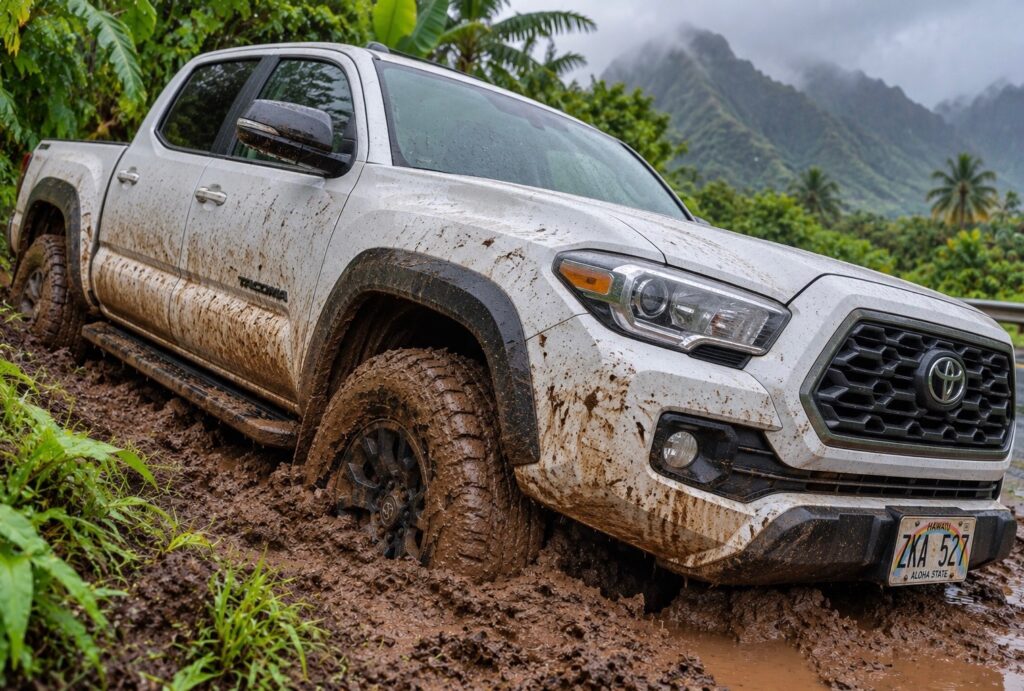
If your vehicle becomes stuck in mud or difficult terrain, one of the most common reactions is to press harder on the accelerator.
That can make the situation worse.
Spinning the tires can dig them deeper into soft ground. What started as a vehicle with limited traction can quickly become a vehicle buried deeply enough to require a more complicated recovery.
Instead, stop and evaluate the situation.
If you’re stuck and cannot safely get the vehicle moving, call for help immediately. Hawaii Towing Company provides roadside assistance for Oahu drivers dealing with breakdowns, disabled vehicles, and other roadside situations. Give us as much information as possible about your vehicle, location, and road conditions so we can determine the safest way to help.
Don’t Try to Pull the Vehicle Out With Improvised Equipment
Another mistake we see is attempting a recovery using whatever happens to be available.
Drivers may try ropes, chains, straps, or another vehicle without fully understanding the forces involved.
The attachment point matters. The direction of the pull matters. The weight of the vehicle matters.
Using an incorrect attachment point or recovery method can damage the vehicle. It can also create a dangerous situation for the people standing nearby.
A stuck vehicle may look like it only needs a quick pull, but professional vehicle recovery requires much more consideration.
What We Look at Before Beginning an Off-Road Recovery
When Hawaii Towing Company responds to a muddy-road, flood-related, or off-road recovery, we evaluate the situation before beginning.
Some of the most important factors include:
- Vehicle weight
- Drivetrain
- How deeply the vehicle is stuck
- The angle and position of the vehicle
- Available recovery and attachment points
- Ground stability
- Water depth and movement
- Surrounding obstacles
- Distance from a stable roadway
- Whether the tow truck can be positioned safely
That last point is especially important.
We cannot safely recover one stuck vehicle by putting the tow truck in a position where it may also become stuck or endangered.
The truck needs a stable location where the operator can safely perform the recovery.
Off-Road Recovery Isn’t Just Hooking Up a Winch
Vehicle recovery can look simple from the outside.
Hook up a cable and pull the vehicle out, right?
Not necessarily.
Before we use a winch, we need to understand how the vehicle is positioned, where we can safely connect, the direction it needs to move, and whether the surrounding ground can support the recovery.
We also have to consider the vehicle’s drivetrain, weight, clearance, and condition.
The safest recovery method depends on the situation in front of us.
Sometimes a winch and flatbed may be appropriate. Other situations may require different equipment, additional straps, careful positioning, or a different approach altogether.
When a Tow Becomes a Vehicle Recovery
There is an important difference between a standard tow and recovering a vehicle from difficult terrain.
If your vehicle is sitting safely on pavement and simply won’t start, loading it onto a tow truck can be relatively straightforward.
A vehicle buried in mud is different.
Several factors can turn a tow into a more complicated recovery, including:
- Deep mud
- Unstable ground
- Difficult vehicle angles
- Limited access
- Distance from a paved road
- Floodwater
- Obstacles surrounding the vehicle
- Additional winching requirements
These situations can require more time, equipment, preparation, and planning.
Our goal isn’t simply to get the vehicle moving. We want to determine how to recover it without creating additional damage or unnecessary risk.
Give the Towing Company Accurate Information
When you call for help, the information you provide can make a significant difference.
For an off-road or flood-related recovery, we want to know about the vehicle, water or mud depth, exact location, road conditions, how far the vehicle is from a stable roadway, and whether the wheels are spinning or buried.
We also want to know whether you are currently in a dangerous situation.
Photos can also be helpful when they can be taken safely. Seeing the position of the vehicle and surrounding terrain may help us understand what equipment could be required before we arrive.
The more accurate the information, the better prepared we can be.
Safety Comes Before the Vehicle
A vehicle can be repaired or replaced. Your safety comes first.
If heavy rain is creating flash-flood conditions, don’t take unnecessary chances simply because you need to reach your destination.
Slow down.
Don’t drive through water when you don’t know its depth or the condition of the road underneath.
If your vehicle becomes stuck, avoid repeatedly spinning the tires and making the situation worse.
Most importantly, call for help immediately when you’re unable to safely continue.
Off-Road Recovery on Oahu
Oahu’s weather and terrain can create situations that are very different from a normal roadside breakdown.
At Hawaii Towing Company, more than 15 years of towing experience has taught us to evaluate each recovery individually.
Before we move a vehicle, we consider its weight, drivetrain, position, available recovery points, terrain, water movement, surrounding obstacles, and the safest place to position our equipment.
We don’t want to turn one problem into two.
Whether you’re dealing with a muddy road, difficult terrain, or a vehicle that needs to be recovered after severe weather, the first priority should always be keeping everyone safe.
If you’re stuck and need professional help, contact Hawaii Towing Company. Explain the situation in as much detail as possible so we can determine the safest approach and arrive prepared for the recovery.