

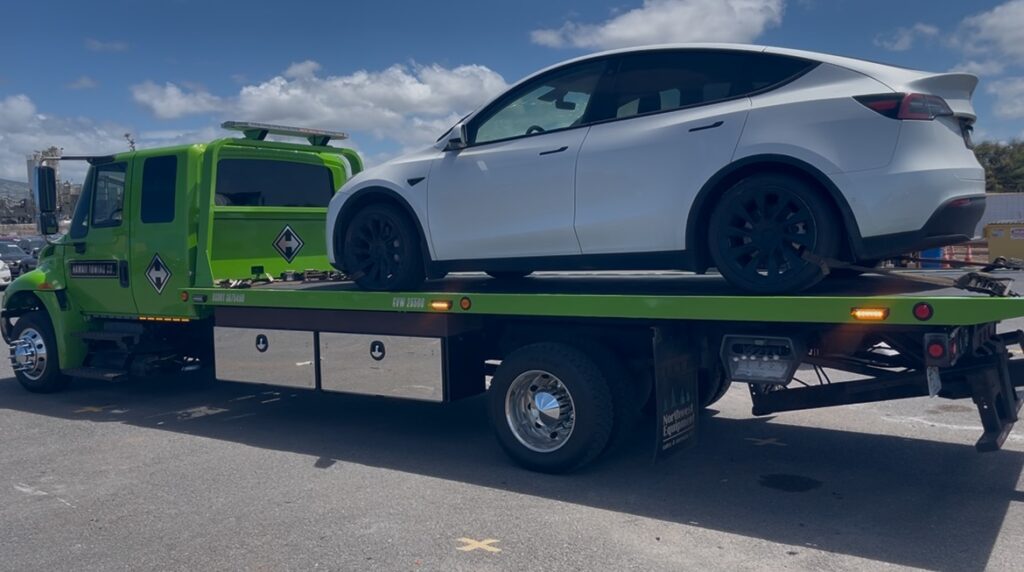
Electric vehicles are changing the way people drive. From Tesla and Rivian to Hyundai, Kia, and other manufacturers, more drivers are considering the switch from gasoline to electricity.
But how much do you really know about electric vehicles?
While EVs offer several advantages, they also come with challenges that every owner should understand. Charging costs, battery life, maintenance, and unexpected breakdowns are all important considerations.
At Hawaii Towing Company, we have over 15 years of towing experience on Oahu. Over the years, we have worked with different types of vehicles, including electric cars that require special handling and transportation.
Through our experience, we have learned that electric vehicles are not necessarily more complicated than gasoline-powered cars. However, they operate differently, especially when something goes wrong.
In this article, we’ll explain how electric vehicles work, their advantages and disadvantages, common problems, and what Oahu drivers should know before buying or towing one.
What Is an Electric Vehicle?
An electric vehicle, commonly called an EV, uses an electric motor to power its wheels.
Unlike traditional gasoline-powered vehicles, fully electric cars do not rely on an internal combustion engine. Instead, they store electricity in a rechargeable battery pack.
When you press the accelerator, electricity flows from the battery through the vehicle’s power electronics to the electric motor.
This allows the vehicle to move without burning gasoline.
Some popular electric vehicles include:
- Tesla Model 3, Model Y, Model S, and Model X
- Rivian R1T and R1S
- Hyundai IONIQ 5 and IONIQ 6
- Kia EV6 and EV9
- Ford Mustang Mach-E and F-150 Lightning
- Chevrolet Equinox EV and Silverado EV
- Lucid Air
- Polestar electric vehicles
Although these vehicles operate on similar principles, their battery systems, towing procedures, and emergency features can differ.
That is why understanding your specific vehicle is so important.
How Do Electric Vehicles Work?
Electric vehicles use several important components to operate.
High-Voltage Battery
The high-voltage battery stores the energy needed to drive the vehicle.
Most modern electric vehicles use lithium-ion battery technology. Battery capacity varies depending on the vehicle’s make and model.
Larger batteries generally provide more driving range, although vehicle efficiency also plays an important role.
Electric Motor
Instead of a gasoline engine, an electric motor converts electrical energy into mechanical movement.
Electric motors can deliver torque almost instantly. This is one reason many electric vehicles accelerate quickly.
Low-Voltage Battery
Many EV owners do not realize their vehicles also have a separate low-voltage electrical system.
Depending on the model, this system may use a 12-volt battery or another low-voltage configuration.
It powers important electronics, computers, locks, and control systems.
If the low-voltage system fails, the vehicle may become unresponsive even when the main battery still has energy.
We have personally encountered this situation while towing a Tesla on Oahu.
We’ll explain that experience later in this article.
Regenerative Braking
Electric vehicles also use regenerative braking.
When you slow down, the electric motor can recover some of the vehicle’s kinetic energy and return it to the battery.
This improves efficiency and can reduce wear on conventional brakes.
However, regenerative braking does not eliminate the need for regular brake inspections.
Advantages of Owning an Electric Vehicle on Oahu
There are several reasons why electric vehicles appeal to Hawaii drivers.
1. No Gasoline Required
One of the biggest advantages of owning a fully electric vehicle is eliminating gasoline purchases.
Instead of visiting a gas station, owners recharge their vehicles at home or at public charging stations.
Depending on electricity rates, vehicle efficiency, and charging habits, this can reduce operating costs.
However, Hawaii has relatively high electricity prices. Therefore, drivers should compare their actual charging costs against gasoline expenses.
2. Less Routine Maintenance
Electric vehicles generally require fewer routine powertrain maintenance services than gasoline-powered cars.
For example, fully electric vehicles do not need traditional engine oil changes, spark plugs, or exhaust system repairs.
However, they still require maintenance.
Important items include:
- Tires and wheel alignment
- Brake inspections
- Suspension components
- Cabin air filters
- Cooling systems
- Battery and electrical system inspections
Regular maintenance remains important for vehicle safety and reliability.
3. Convenient Home Charging
For drivers who can install a home charging system, owning an EV can be convenient.
Instead of stopping at a gas station, you can charge your vehicle overnight.
This is especially helpful for people who drive predictable daily routes.
However, apartment and condominium residents may have fewer charging options.
4. Quiet and Smooth Driving
Electric vehicles typically operate more quietly than gasoline-powered vehicles.
They also deliver smooth acceleration without traditional transmission shifts in most models.
For many drivers, this makes daily commuting more comfortable.
5. No Tailpipe Emissions
Fully electric vehicles produce no tailpipe emissions while driving.
However, electricity generation and battery manufacturing still have environmental impacts.
The overall environmental benefit depends partly on how the electricity is produced.
Disadvantages of Electric Vehicles in Hawaii
Although electric vehicles have many benefits, they are not perfect for everyone.
Before purchasing one, Oahu drivers should understand several potential disadvantages.
1. Hawaii’s Electricity Costs
Electricity in Hawaii is generally more expensive than in many mainland states.
Therefore, charging an EV may not provide the same savings that drivers experience elsewhere.
Home solar systems and favorable charging rates may help reduce costs.
However, actual savings depend on your household’s energy situation.
2. Limited Charging Convenience
Public charging stations are available around Oahu, but accessibility varies.
Some charging stations may be occupied, unavailable, or incompatible with a vehicle without the appropriate equipment.
Additionally, charging takes longer than filling a gasoline tank.
Drivers who cannot charge at home should carefully consider their charging options.
3. Battery Replacement Costs
The high-voltage battery is one of the most expensive components of an electric vehicle.
Although modern EV batteries are designed for long service lives, replacements can be costly outside warranty coverage.
Battery lifespan depends on factors such as temperature, usage, charging habits, and battery management.
4. Specialized Repairs
Electric vehicles contain high-voltage electrical systems that require specialized training and equipment.
Not every repair facility has the tools or experience to diagnose these systems.
This can make certain repairs more complicated.
5. Special Towing Requirements
One disadvantage that many EV owners overlook is the need for proper towing procedures.
Some electric vehicles can suffer serious drivetrain damage if their wheels rotate on the ground during transportation.
That is why EV owners should choose a towing company familiar with their vehicle’s manufacturer guidelines.
At Hawaii Towing Company, we use flatbed towing for electric vehicles to keep all four wheels off the road during transport.
Common Electric Vehicle Problems We’ve Encountered
Through our towing experience on Oahu, we have dealt with different situations involving electric vehicles.
While EVs can be dependable, they can still experience unexpected problems.
Dead High-Voltage Batteries
Just like a gasoline vehicle can run out of fuel, an electric vehicle can run out of usable battery energy.
When this happens, the vehicle may stop operating and require transportation to a charging location or repair facility.
Dead Low-Voltage Batteries
A failed low-voltage battery can prevent an EV from starting or responding to commands.
In some situations, owners cannot unlock certain functions or activate the vehicle’s towing mode.
This can complicate the loading process.
Transport Mode Problems
Many electric vehicles have a special setting that allows the vehicle to be moved safely during recovery.
Tesla calls this feature Transport Mode.
However, the process varies between manufacturers.
If the vehicle cannot enter its required towing or loading mode, additional equipment or procedures may be necessary.
Flat Tires and Wheel Damage
Electric vehicles can experience flat tires, damaged wheels, and suspension problems just like gasoline-powered vehicles.
However, EV weight, tire specifications, and lifting requirements may affect the recovery process.
Electrical and Software Malfunctions
Electric vehicles rely heavily on electronic control systems.
A malfunction can sometimes prevent the vehicle from operating normally.
In certain situations, the safest solution is to transport the vehicle to a qualified service facility.
Accident Damage
An EV involved in an accident may have damage that is not immediately visible.
Battery enclosures, high-voltage components, and electrical wiring require special attention.
If the battery system appears damaged, operators should follow the manufacturer’s emergency response procedures and avoid unnecessary contact with high-voltage components.
Our Real Experience Towing a Tesla With a Dead Low-Voltage Battery
One experience that stands out involved a Tesla that would not operate because of a dead low-voltage battery.
The situation presented a challenge because the vehicle could not initially enter Transport Mode.
For anyone unfamiliar with Tesla vehicles, Transport Mode allows the vehicle to roll during controlled loading and recovery.
Without the correct preparation, attempting to move the vehicle can create unnecessary risks.
How We Handled the Situation
Before loading the Tesla, we assessed the vehicle and determined what was preventing it from entering Transport Mode.
We then used a jump pack to provide temporary low-voltage power through the appropriate connection.
Once the vehicle had sufficient power, we were able to activate Transport Mode.
With the vehicle properly prepared, we carefully loaded it onto our flatbed tow truck.
Throughout the process, we monitored the vehicle and followed the appropriate loading procedures.
What This Experience Taught Us
This situation demonstrates why electric vehicle towing requires specialized knowledge.
A towing operator unfamiliar with Tesla procedures might attempt to drag the vehicle without properly preparing it.
That can create unnecessary stress on vehicle components.
However, understanding the vehicle’s systems can make the recovery process safer and more efficient.
Important: Low-voltage power restoration procedures differ between EV models. Owners should never attempt to jump-start a high-voltage traction battery. Always follow the manufacturer’s instructions.
Why Electric Vehicles Should Be Towed With the Proper Equipment
One of the biggest mistakes during electric vehicle towing is assuming that every vehicle can be transported like a traditional gasoline-powered car.
Many EVs have drivetrain configurations that require special precautions.
For example, several Tesla models use all-wheel-drive systems.
Allowing the wheels to rotate on the ground during towing can damage drivetrain components.
Why We Prefer Flatbed Towing
At Hawaii Towing Company, we use flatbed tow trucks when transporting electric vehicles.
This method provides several advantages:
- Keeps all four wheels off the ground
- Helps protect drivetrain components
- Reduces unnecessary tire movement
- Provides a stable platform for transportation
- Allows controlled loading and securing
However, a flatbed alone does not guarantee a safe recovery.
The operator must also understand the correct loading procedures, vehicle weight, attachment points, and manufacturer requirements.
For disabled vehicles that cannot roll freely, additional recovery equipment may be necessary.
Learn more about our special vehicle towing services on Oahu, including professional transportation for electric, luxury, lowered, and modified vehicles.
What Every EV Owner Should Know Before Calling a Tow Truck
If your electric vehicle breaks down, there are several things you should communicate to the towing company.
Before dispatching a truck, we prefer to understand the vehicle’s condition and any challenges we might encounter.
Important questions include:
- What is the vehicle’s make, model, and year?
- Is the vehicle all-wheel drive or two-wheel drive?
- Can the vehicle enter Transport Mode or its equivalent?
- Is the low-voltage electrical system working?
- Does the vehicle have an accessible tow eye or approved recovery point?
- Is the vehicle lowered or equipped with a body kit?
- Are there damaged wheels or suspension components?
- Was the vehicle involved in an accident?
- Where is the vehicle located?
- Where does the vehicle need to be transported?
These details help us determine which equipment and procedures may be necessary.
For example, a Tesla with a dead low-voltage battery may require a different loading approach than an EV with a simple flat tire.
Asking the right questions before arriving can prevent unnecessary delays.
Tips for Owning an Electric Vehicle on Oahu
If you already own an EV or are considering buying one, here are some practical recommendations.
Understand Your Vehicle’s Charging Requirements
Learn how long your vehicle takes to charge and which charging equipment it supports.
Also, identify reliable charging locations near your home, workplace, and regular destinations.
Learn How Transport Mode Works
Every EV owner should become familiar with their manufacturer’s emergency towing instructions.
You do not need to become a mechanic.
However, knowing where to find this information can help when your vehicle becomes disabled.
Understand Your Battery Systems
Remember that the main high-voltage battery and the low-voltage electrical system serve different purposes.
A problem with either system can prevent the vehicle from operating normally.
Follow Recommended Maintenance
Although EVs require fewer traditional engine services, they still need regular inspections.
Pay attention to tires, brakes, suspension, cooling systems, and manufacturer-recommended maintenance.
Choose an Experienced EV Towing Company
Not every towing company has experience transporting electric vehicles.
Before requesting service, ask whether the operator understands your vehicle’s towing requirements.
A qualified operator should know how to identify safe loading procedures and when additional equipment is needed.
Are Electric Vehicles Worth Buying in Hawaii?
Electric vehicles can be an excellent choice for many Oahu drivers.
Because Oahu is an island, many residents travel relatively short daily distances compared with drivers who regularly take long mainland road trips.
For someone with convenient home charging, an EV may fit their daily routine very well.
However, ownership costs and charging convenience should still be considered.
Electricity prices, insurance, battery warranty coverage, purchase price, and repair availability all affect the overall ownership experience.
Ultimately, the right choice depends on your driving habits, budget, and charging access.
From our perspective as towing professionals, electric vehicles are simply another category of vehicle that requires the proper knowledge and equipment.
They offer exciting technology and practical benefits, but owners should also understand their limitations.
Frequently Asked Questions About Electric Vehicles
Can You Tow a Tesla With a Regular Tow Truck?
Tesla vehicles have specific towing requirements. Tesla generally requires transportation with all four wheels off the ground, typically using a flatbed. Operators must follow the instructions for the particular model.
What Happens if an Electric Vehicle Runs Out of Battery?
When an EV runs out of usable driving energy, it may become disabled and require roadside charging or transportation to an appropriate charging facility.
Do Electric Vehicles Have 12-Volt Batteries?
Many electric vehicles use a 12-volt battery, while some newer models use different low-voltage systems. These systems power important electronics and vehicle controls.
Are Electric Vehicles More Expensive to Maintain?
EVs generally have fewer routine powertrain maintenance requirements. However, certain repairs, especially high-voltage battery or electrical repairs, can be expensive.
Can a Dead Tesla Be Put Into Transport Mode?
In some situations, restoring low-voltage power through the manufacturer-approved procedure may allow Transport Mode to activate. However, the correct procedure depends on the model and the vehicle’s condition.
Is Flatbed Towing Better for Electric Vehicles?
Flatbed towing is generally preferred for many EVs because it keeps all four wheels off the road. Operators must still follow the manufacturer’s specific loading and transportation instructions.
Final Thoughts: Understanding Electric Vehicles Makes Ownership Easier
Electric vehicles are becoming an important part of modern transportation.
They offer quiet operation, reduced routine maintenance, and the convenience of charging instead of purchasing gasoline.
However, they also come with unique challenges.
Understanding battery systems, charging requirements, emergency procedures, and proper towing methods can help owners prepare for unexpected situations.
At Hawaii Towing Company, our experience has taught us that every vehicle deserves careful handling, regardless of whether it runs on gasoline or electricity.
We believe in taking the time to understand each vehicle before attempting to move it.
After all, we treat every vehicle as if it were our own.
Need Electric Vehicle Towing on Oahu? Call Hawaii Towing Company!
If your Tesla or other electric vehicle breaks down, choosing an experienced towing company matters.
Hawaii Towing Company provides professional 24-hour towing services throughout Waipahu, Ewa Beach, Kapolei, Pearl City, Mililani, Wahiawa, Honolulu, and communities across Oahu.
With over 15 years of towing experience, proper flatbed equipment, upfront pricing, and accurate arrival estimates, we’re ready to help when you need us.
We’re also proud to have been recognized by ThreeBestRated as one of the Top 3 Towing Companies in Honolulu.
This recognition reflects our commitment to providing dependable towing services and treating every customer’s vehicle with care.
Call Hawaii Towing Company at (808) 672-7711 for dependable electric vehicle towing on Oahu.