

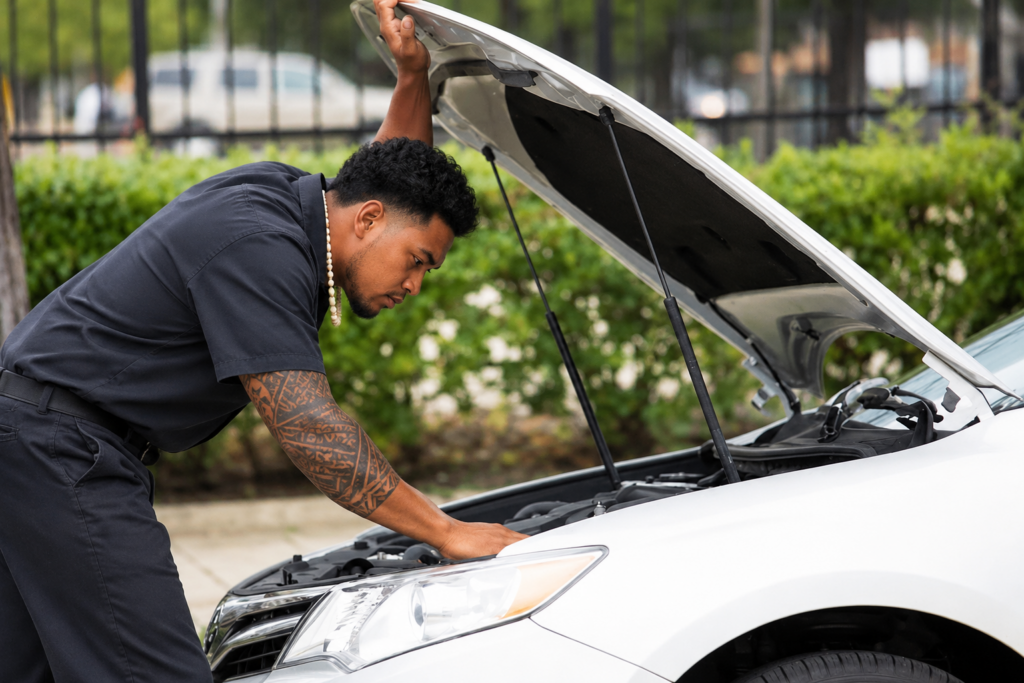
Knowing how to jump start a car without damage may seem simple. However, after more than 15 years in the towing and roadside assistance business, we have seen how quickly a simple jump-start can go wrong.
At Hawaii Towing Company, we have responded to thousands of roadside situations across Oahu. Dead batteries are common, but connecting jumper cables without checking the vehicle first can create a much bigger problem.
One mistake we see is connecting cables to the wrong battery terminals. We have also seen drivers use the wrong grounding point or repeatedly try to start a vehicle that has another problem.
In one case, a customer connected the jumper cables to the wrong terminals. The mistake caused an electrical short in the vehicle. What started as a dead battery became a much more serious electrical problem.
That is why our advice is simple: never rush a jump-start.
Before connecting anything, make sure you understand what caused the vehicle to stop. Then, inspect the battery and identify the correct terminals. If something does not look or smell right, calling a professional may be the safer choice.
Start With Your Safety
Before worrying about the battery, consider where the vehicle is located.
If the car is sitting somewhere dangerous and can safely be pushed, move it to a safer location first. Getting away from moving traffic should take priority over getting the vehicle started.
Once the vehicle is in a safe location, turn it completely off.
Before attempting a jump-start:
- Turn the vehicle off.
- Make sure the vehicle is in Park or the appropriate gear.
- Apply the parking brake.
- Identify the positive and negative battery terminals.
- Inspect the battery for obvious damage.
- Look for damaged or loose cables.
- Check for heavy corrosion.
- Pay attention to unusual smells or signs of smoke.
- Follow the vehicle manufacturer’s jump-start instructions.
Newer vehicles can also have designated jump points instead of simple direct battery connections. Therefore, check the owner’s manual if you are unsure.
Inspect the Battery Before Connecting Jumper Cables
One of the most important lessons we have learned is that you should not assume every car that will not start simply has a dead battery.
Take a moment to inspect the situation first.
Look at the battery and surrounding area. If you notice a swollen or damaged battery, leaking fluid, severe corrosion, damaged wiring, or another obvious problem, stop.
Likewise, pay attention to what happened immediately before the vehicle stopped running.
Did you smell something burning?
Did you see smoke?
Did you smell something similar to burnt plastic?
If so, you may be dealing with an electrical problem rather than a simple dead battery.
Do Not Jump a Vehicle That May Have an Electrical Short
This is one situation where we strongly recommend against experimenting with a jump-start.
If the vehicle stopped after an apparent electrical short, do not immediately introduce power back into the electrical system.
A burning or burnt-plastic smell can be an important warning sign. Smoke or visible wiring damage should also be taken seriously.
Based on our experience, we would rather tow that vehicle than risk creating additional damage.
When our towing team identifies signs that a vehicle may have experienced an electrical short, we generally do not attempt to jump it. Instead, when the vehicle and situation allow it, we can place the vehicle in neutral and tow it to a location where the electrical problem can be properly inspected.
Putting power back into a system with an unknown electrical fault is simply not worth the risk.
Identify the Positive and Negative Terminals
Another critical step is identifying the correct battery terminals before attaching any cables.
Never guess.
The positive terminal is normally marked with a plus (+) symbol, while the negative terminal carries a minus (-) symbol. However, battery locations and approved connection points can vary between vehicles.
Therefore, check the owner’s manual when there is any uncertainty.
Connecting cables incorrectly can cause sparks, blown fuses, electrical damage, or other serious problems. As our customer’s experience showed, reversing the connections can turn a simple roadside problem into an expensive repair.
How to Connect Jumper Cables Safely
If the battery appears safe and the manufacturer’s instructions allow a conventional jump-start, make each connection carefully.
A common sequence is:
- Connect the red positive clamp to the positive terminal of the dead battery.
- Connect the other red clamp to the positive terminal of the good battery or approved jump source.
- Connect the black negative clamp to the negative terminal of the good battery or jump source.
- Make the final negative connection to the grounding point specified for the disabled vehicle.
However, your vehicle manufacturer’s instructions should take priority over generic directions. Some vehicles have specific jump terminals or grounding points.
Keep the clamps separated while making the connections. Also, make sure each clamp has a secure connection before moving to the next one.
If you cannot confidently identify the terminals or grounding point, stop and get professional help.
Why the Grounding Point Matters
Drivers often focus on the positive and negative terminals but overlook the final ground connection.
A proper grounding point helps complete the circuit safely. However, the correct location can vary by vehicle.
For that reason, do not simply attach the final clamp to whichever piece of metal is easiest to reach. Instead, use the grounding location recommended by the vehicle manufacturer.
Again, when you are unsure, the owner’s manual is your friend.
What to Do After the Car Starts
Getting the engine started does not necessarily mean the problem has been solved.
When we jump-start a customer’s vehicle, we do not immediately assume everything is fine. Instead, we typically wait about three to five minutes and watch how the vehicle behaves.
One reason is the alternator.
The battery provides the power needed to start the engine. Once the engine runs, the charging system should help maintain the electrical system and recharge the battery.
If the alternator is failing, the jump may provide enough power to get the engine running temporarily. However, the vehicle could lose power and shut down again once that temporary charge is gone.
That can leave the driver stranded for a second time.
Get Your Battery and Charging System Checked
If your vehicle starts and continues running, do not assume the problem is over.
We recommend having the battery checked as soon as possible. In addition, consider having the charging system tested, especially if you do not know why the battery went dead.
A weak battery may need replacement. Alternatively, the alternator or another electrical component could be causing the problem.
Warning signs that deserve further inspection include:
- The vehicle dies again shortly after the jump.
- Dashboard or battery warning lights remain on.
- Electrical accessories behave strangely.
- The engine struggles to restart.
- The battery repeatedly loses its charge.
- You notice burning smells or electrical odors.
- Lights become unusually dim while the engine runs.
A jump-start should help you address the immediate problem. It should not replace finding out why the battery lost power.
When You Should Call a Towing Company Instead
There is nothing wrong with deciding that a jump-start is outside your comfort level.
In fact, knowing when not to jump a vehicle can prevent additional damage.
Consider calling a professional if:
- You cannot identify the correct battery terminals.
- You do not know the proper grounding point.
- The battery appears swollen, cracked, or damaged.
- Battery fluid appears to be leaking.
- Heavy corrosion is present.
- Cables or wiring appear damaged.
- You smell burnt plastic or an electrical odor.
- Smoke appeared before the vehicle stopped.
- The vehicle may have experienced an electrical short.
- The vehicle was recently involved in an accident.
- You are unsure why the vehicle lost power.
- Your vehicle has special manufacturer jump-start procedures.
After more than 15 years of towing and roadside assistance experience, we believe one principle matters most: do not take an unnecessary risk just to get the engine running.
Sometimes the safest roadside assistance is a professional jump-start. Other times, especially when there are signs of an electrical problem or the vehicle cannot be safely driven, the safest choice is a tow.
The Biggest Jump-Start Mistakes We See
Many jump-start problems happen because drivers are frustrated or in a hurry.
Over the years, we have seen many of the same mistakes repeatedly. These include connecting cables to the wrong terminals, choosing an improper ground, ignoring battery damage, and continuing to crank an engine that will not start.
Another mistake is assuming the battery caused the problem simply because the vehicle has no power.
That assumption can be especially risky when an electrical issue occurred immediately before the vehicle stopped.
Take a few extra minutes to evaluate the situation. Those minutes could save you from turning a dead battery into a damaged electrical system.
How to Jump Start a Car Without Damage: Our Final Advice
After more than 15 years of helping stranded drivers, our most important advice is straightforward.
Slow down and check before you connect.
Turn the vehicle off. Move it to a safe location when possible. Identify the correct positive and negative terminals. Inspect the battery and wiring. Then, follow the manufacturer’s recommended jump-start procedure.
Most importantly, pay attention to what your vehicle is telling you.
If you smelled burnt plastic, noticed smoke, or believe an electrical short caused the vehicle to stop, do not attempt to restore power without knowing what went wrong. In that situation, we recommend having the vehicle inspected first.
At Hawaii Towing Company, we would rather safely tow a vehicle with a suspected electrical problem than risk causing more damage by introducing power into a faulty system.
Finally, if the jump works, give the vehicle a few minutes and watch how it behaves. Then, get the battery and charging system checked as soon as possible.
Knowing how to jump start a car without damage is not just about connecting cables in the right order. It is also about recognizing when a jump-start is safe, when something is wrong, and when calling an experienced towing professional is the smarter choice.