

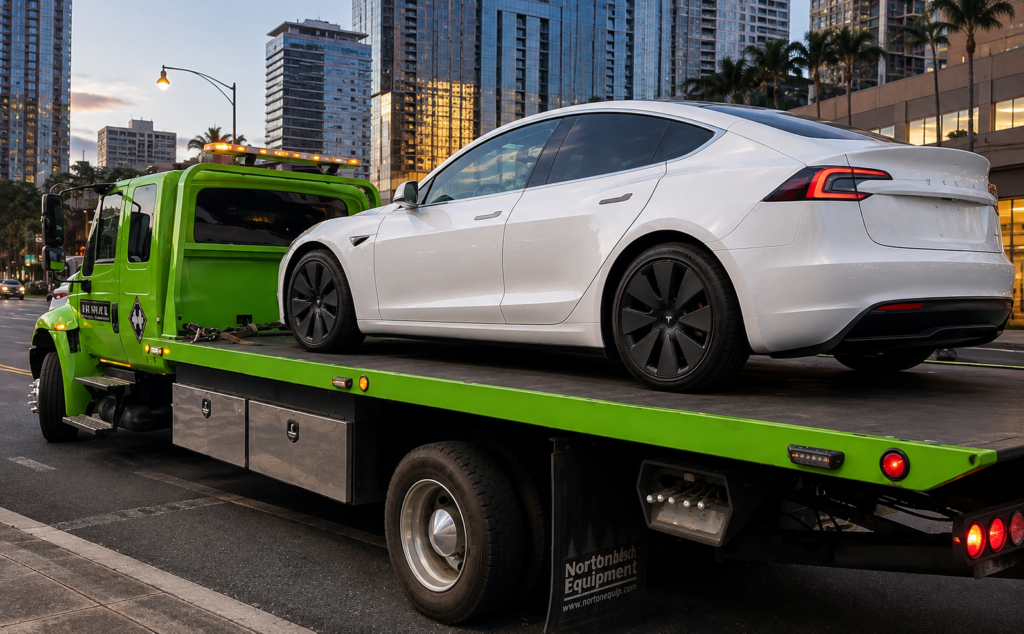
Knowing how to tow a Tesla safely requires special vehicle towing knowledge because an electric vehicle cannot always be handled like a typical gas-powered car. The drivetrain, low-voltage electrical system, ground clearance, and proper loading procedure should all be considered before the vehicle is moved.
At Hawaii Towing Company, we have more than 15 years of towing experience. During that time, we have transported many different types of vehicles, including Teslas, electric vehicles, and other specialty vehicles. One of the most important lessons we have learned is simple: the tow should never be rushed at the expense of the vehicle.
When a Tesla needs to be transported, we prefer a flatbed tow truck. More importantly, a flatbed is also recommended by Tesla for transporting its vehicles. Keeping all four wheels off the ground helps protect the vehicle while it is being transported.
Why Special Vehicle Towing Matters for a Tesla
One of the biggest mistakes we see in the towing industry is allowing a Tesla’s wheels to remain on the ground during transport.
Many Teslas are equipped with all-wheel drive. However, keeping all four wheels off the ground is important beyond AWD alone. Tesla warns that its motors can generate power when the wheels spin during transport. For that reason, Tesla instructs that all four tires should be kept off the ground and prevented from spinning during transportation.
This is one reason we believe Tesla owners should be careful when choosing a towing company. Proper special vehicle towing requires the operator to understand the vehicle before attempting to move it.
Why We Prefer a Flatbed Tow Truck for a Tesla
A flatbed tow truck is our preferred way to transport a Tesla. Tesla also recommends a flatbed truck or comparable transport vehicle as its preferred transportation method.
With a flatbed, the entire Tesla can be loaded onto the bed. Therefore, all four tires remain off the roadway during transportation.
A flatbed can provide several advantages:
- All four wheels can be kept off the ground.
- Unnecessary wheel rotation during transport can be prevented.
- The vehicle can be secured on the flatbed.
- Low-clearance areas can be considered during loading.
- The Tesla can be transported without simply pulling it behind the tow truck.
Tesla does provide an alternative method using wheel lifts and dollies under specific conditions. However, all four wheels still need to be kept off the ground.
From our experience, if a flatbed can safely be used, that is the method we prefer.
Transport Mode Is Important for Special Vehicle Towing
Before a Tesla is loaded, we want to know whether the vehicle can be placed into Transport Mode, which Tesla also refers to as Tow Mode in some current owner documentation.
This mode allows the vehicle to free-roll so it can be moved slowly for a very short distance or winched onto a flatbed.
This is not the same as putting a conventional vehicle into neutral and towing it down the road. Transport Mode is intended to help position and load the Tesla.
Before we arrive, this is one of the questions we may ask the customer:
Can the Tesla be put into Transport Mode?
The answer gives us valuable information about what we may encounter when we arrive. Asking these questions beforehand is an important part of safe special vehicle towing.
A Tesla We Couldn’t Initially Put Into Transport Mode
We once responded to a Tesla that could not initially be placed into Transport Mode because the vehicle’s low-voltage system did not have the power needed to access the function.
Instead of trying to force the vehicle onto the flatbed, the electrical issue was addressed first.
A jump pack was connected to provide the needed low-voltage power. Once power was restored, we were able to access the Tesla’s controls and put the vehicle into Transport Mode.
The Tesla could then be loaded properly.
This is a good example of why experience with electric vehicles matters. A tow operator should understand why the vehicle will not move before attempting to force it to move.
Tesla’s own instructions state that low-voltage power is needed to enable Tow Mode. If low-voltage power is unavailable, Tesla instructs transporters to attempt to jump-start the low-voltage system so the touchscreen can be used.
What If the Tesla Cannot Be Put Into Transport Mode?
This is where we believe judgment becomes just as important as equipment.
If we cannot safely get a customer’s Tesla into the condition needed for loading with the method available to us, we are not going to force the vehicle onto our truck simply because we were called to tow it.
Instead, we help the customer determine an alternative solution.
That may mean another transportation method or equipment is needed for that particular situation.
Tesla’s instructions also address situations where Tow Mode is unavailable or the touchscreen cannot be accessed. Depending on the model and circumstances, self-loading dollies or tire skates may be required to place the vehicle into an approved transportation position.
The correct procedure should be determined for the specific Tesla and situation.
In our opinion, knowing when not to proceed is an important part of professional towing. Completing a tow is never worth causing unnecessary damage to a customer’s vehicle.
The Tow Eye Should Be Discussed Before the Truck Arrives
Another question we may ask is whether the Tesla’s tow eye is available.
This small detail can make a big difference when preparing to load the vehicle.
Tesla’s instructions specify using a properly installed tow eye when pulling certain models onto a flatbed. Tesla also cautions that using the chassis, frame, or suspension components incorrectly can cause damage.
That is why we like to gather as much information as possible before dispatch.
A few questions on the phone can help the tow operator arrive better prepared.
Modified Teslas Require Special Vehicle Towing Experience
We also ask whether anything has been added to or modified on the vehicle.
For example, does the Tesla have an aftermarket body kit?
A Tesla may already have areas where clearance needs to be considered. An aftermarket front lip, side skirt, lowered suspension setup, or other modification can create additional loading concerns.
This information should be known before the vehicle is pulled onto the flatbed.
The loading angle can then be evaluated, and additional precautions can be taken when appropriate.
From our experience, customers do not always realize that a modification is important information for a towing company. We would rather have too much information before arriving than discover an important modification halfway through loading the vehicle.
This attention to vehicle design and modifications is one of the reasons special vehicle towing experience can be valuable when transporting a Tesla.
Questions We Ask Before Towing a Tesla
When someone calls Hawaii Towing Company about transporting a Tesla, we want to understand the situation before simply sending a truck.
Depending on the situation, some of the questions we may ask include:
- Can the Tesla be placed into Transport Mode?
- Is the vehicle all-wheel drive?
- Is the tow eye available?
- Does the vehicle have an aftermarket body kit?
- Has the Tesla been lowered or otherwise modified?
- What caused the vehicle to become disabled?
- Is there anything about its location that could make loading difficult?
These questions are asked for a reason.
The more we know before arriving, the better prepared we can be to determine how the vehicle should be handled.
What Tesla Owners Should Ask a Towing Company
If there is one piece of advice we would give Tesla owners, it is this:
Ask the towing company whether they have experience transporting Teslas before allowing them to move your vehicle.
Do not assume that every towing company handles every vehicle the same way.
A company with special vehicle towing experience should understand why the vehicle’s condition matters. They should also be willing to ask questions before dispatching a truck.
For example, if you call and say that your Tesla will not move, we want to know more.
Can you access the touchscreen? Can Transport Mode be activated? Is the vehicle modified? Is the tow eye available?
Those details can change how the situation should be approached.
A Tesla Should Not Simply Be Dragged Onto a Tow Truck
When a disabled vehicle refuses to roll, it can be tempting to think that enough pulling force will solve the problem.
With a Tesla, that approach can create unnecessary risk.
The reason the wheels are not moving should be understood first. If Transport Mode cannot be activated, the appropriate procedure for that particular Tesla should be determined before loading continues.
The tow point also matters. Tesla provides specific instructions about where and how its vehicles should be pulled onto a flatbed.
In other words, more force is not a substitute for the correct procedure.
That principle applies to many specialty vehicles we transport, not only Teslas. Different vehicles require different loading techniques, equipment, and levels of care to help prevent unnecessary damage.
Extra Care Should Be Taken After an Accident
A Tesla involved in a collision requires additional caution.
Visible body damage may not tell the entire story. High-voltage components can potentially be affected by a collision.
Tesla instructs transporters to assume that high-voltage components may remain energized after a collision until the vehicle has been properly evaluated.
For this reason, an accident-damaged Tesla should never be treated casually. The condition of the vehicle and the accident scene should be considered before transportation begins.
Safety should come before speed.
How to Tow a Tesla Safely: Our Approach
After more than 15 years in the towing business, we have learned that good towing often starts before the tow truck moves anything.
Questions need to be asked. The vehicle needs to be evaluated. The proper equipment needs to be selected.
When we are preparing to transport a Tesla, our priorities include:
- Keeping all four wheels off the ground during transport
- Using a flatbed when appropriate
- Determining whether Transport Mode can be activated
- Checking whether the tow eye is available
- Identifying body kits, lowered suspension, or other modifications
- Avoiding unnecessary dragging or forcing of the vehicle
- Following the appropriate Tesla transport instructions for the specific model
- Choosing another solution if the vehicle cannot be moved safely with the available method
Sometimes the most professional decision is to stop and find another solution.
We would rather explain to a customer that a different method is needed than risk damaging their Tesla just to complete the job.
Choose a Special Vehicle Towing Company With Tesla Experience
If your Tesla needs to be transported, ask questions before choosing a towing company.
Find out whether the company has experience with Teslas and electric vehicles. Ask whether a flatbed will be used and explain the condition of your vehicle as accurately as possible.
Most importantly, tell the towing company if the Tesla cannot enter Transport Mode, has been modified, has accident damage, or is completely without power.
At Hawaii Towing Company, our approach to special vehicle towing is based on preparation, proper equipment, and experience. We believe a vehicle should be treated as if it were our own. That means taking the time to understand the situation before the Tesla is loaded, secured, and transported.
When it comes to towing a Tesla safely, the right equipment matters, but experience and good judgment matter just as much.