

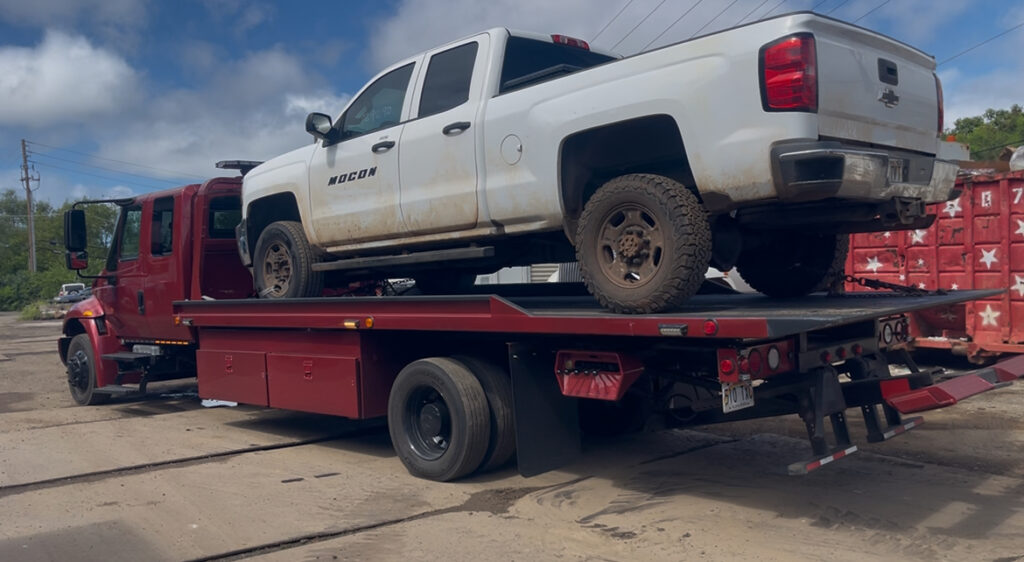
If you need lifted truck towing on Oahu, the towing company needs to know more than your truck’s make and model. A lifted or heavily modified truck can require a completely different towing approach than a standard pickup.
At Hawaii Towing Company, we have more than 15 years of towing experience. Over the years, we’ve learned that four factors are especially important with lifted trucks: height, width, weight, and wheelbase.
Oversized tires, suspension modifications, four-wheel drive, and other custom work can also affect which towing equipment we can safely use.
Before we dispatch a tow truck, we want to understand what we’re dealing with. Asking the right questions beforehand helps us choose appropriate equipment and avoid problems once we arrive.
Why Lifted Truck Towing Is Different
Towing a lifted truck isn’t as simple as sending the same equipment we would use for every pickup.
A factory truck has dimensions that are fairly easy to anticipate. Once an owner starts modifying the suspension, tires, wheels, or other components, those dimensions can change significantly.
From our experience, we pay close attention to:
- Overall truck height
- Overall width
- Tire width
- Vehicle weight
- Wheelbase
- 2WD or 4WD
- Suspension modifications
- Other aftermarket modifications
These details help us determine whether the truck will fit our equipment and which towing method makes the most sense.
Height Is One of the First Things We Need to Know
Height is extremely important when towing a lifted truck.
Many people think only about getting the vehicle onto the tow truck. However, we also have to think about what happens after it’s loaded.
Put a tall lifted truck on top of a flatbed, and the total transportation height increases considerably.
Now we have to think about low overhead obstacles along the route.
That is why knowing the approximate height before dispatch is so important. We don’t want to discover after loading the truck that its overall transportation height creates a clearance problem.
For us, safely towing the vehicle means thinking about the entire trip, not just getting it onto the bed.
Width Can Be Just as Important as Height
The second measurement we pay very close attention to is width.
Lifted trucks often have oversized wheels and tires. On heavily modified trucks, those tires may extend far beyond the factory fender wells.
That can create a problem.
If we’re using a flatbed, we need to know that the truck can sit properly on the bed. We can’t simply load a truck without considering whether its width is appropriate for the equipment.
This is one reason customers should mention oversized wheels and tires when they call.
Saying, “I have a lifted truck,” doesn’t always give us enough information. Tell us how heavily modified it is.
Oversized Tires Can Affect Wheel-Lift Towing
Wide tires can also create challenges when using a wheel-lift tow truck.
Wheel-lift equipment needs to properly accommodate the vehicle’s wheels. When tires are extremely wide or extend significantly beyond the fender wells, standard equipment may not be able to properly grab and support them.
Four-wheel-drive trucks can add another consideration.
Depending on the vehicle and situation, dollies may be needed to keep additional wheels off the roadway. However, dollies also have physical limitations.
If the tires are too wide for the wheel-lift equipment and too wide for the available dollies, our options become much more limited.
This is one situation where a flatbed may become the only practical towing option, assuming the truck safely fits the flatbed.
Does Every Lifted Truck Need a Flatbed?
No.
In our opinion, telling every lifted-truck owner that they automatically need a flatbed is too simple.
Every truck is different.
A mildly lifted pickup with reasonable tire dimensions may present a completely different situation from a heavily modified four-wheel-drive truck sitting on extremely wide tires.
Before deciding how we want to tow it, we consider:
- Height
- Width
- Weight
- Wheelbase
- Tire dimensions
- Drivetrain
- Suspension setup
- Vehicle condition
- Manufacturer towing requirements
- Pickup location
Sometimes a wheel lift can handle the job safely. In other situations, flatbed towing is the better choice.
Then there are situations where the truck’s width, oversized tires, or drivetrain requirements make a properly sized flatbed the practical option.
The important thing is choosing the towing method based on the actual truck rather than making assumptions.
Even a Flatbed Has Limits
Another common misconception is that a flatbed can automatically tow any lifted truck.
That’s not true.
Wheelbase is one reason.
Some trucks can be modified or configured to the point where they’re simply too long for a particular flatbed. The wheels and vehicle need to fit properly on the towing equipment.
Weight also matters.
A towing company needs to know that its truck and equipment have the capacity to safely transport the vehicle.
Then we come back to height and width.
A flatbed doesn’t eliminate those concerns. In some cases, putting a heavily lifted truck onto a flatbed actually makes the height question even more important because the vehicle is now sitting higher off the roadway.
What We Ask Before Towing a Lifted Truck
When someone calls Hawaii Towing Company about a lifted truck, we want details.
We may ask about:
- Year, make, and model
- 2WD or 4WD
- Lift height
- Overall vehicle height
- Tire size
- Tire width
- Wheelbase
- Approximate weight
- Suspension modifications
- Other aftermarket modifications
- What is currently wrong with the truck
- Where the vehicle is located
- Where the vehicle needs to go
All of this information is useful.
However, from our experience, height and width are two of the most important details.
Height helps us determine whether clearance could become an issue during transportation.
Width helps us determine whether the truck can properly fit the towing equipment.
Don’t Hide Your Truck’s Modifications From the Towing Company
Give the towing company accurate information when you call.
If your tires stick far outside the fenders, tell us.
If your truck has a significant suspension lift, tell us.
If it’s unusually long, heavy, or wide, tell us.
The goal isn’t to make your tow more complicated. It’s actually the opposite.
The more we know before dispatch, the better prepared we can be when we arrive.
Sending a tow truck without understanding the vehicle can waste everyone’s time if that equipment cannot safely accommodate the truck.
One Warning Sign We Tell Customers to Watch For
One of the biggest warning signs, in our opinion, is a towing company that just says yes to everything without asking deeper questions.
If you tell someone you have a heavily lifted and modified truck, they should want more information.
They should be asking questions such as:
- How high is the truck?
- How wide are the tires?
- What size tires are on it?
- Is it 2WD or 4WD?
- What is the approximate weight?
- How long is the truck?
- What modifications have been made?
- What happened to the vehicle?
- Where is it located?
Those questions aren’t a sign that the towing company doesn’t know what it’s doing.
In our opinion, they’re often a sign of the opposite.
A towing company needs enough information to determine whether its equipment can properly handle your truck.
Simply saying, “Yes, we can tow anything,” without asking about the vehicle would make us cautious.
Experience Matters With Lifted and Modified Trucks
After more than 15 years in the towing business, we’ve learned not to make assumptions when handling lifted and modified trucks.
Two trucks with the exact same factory make and model can require different towing approaches after their owners modify them.
One may have a mild lift and slightly larger tires.
The other may have a major suspension lift, extremely wide wheels, oversized tires, and a completely different overall height and width.
Those aren’t the same towing job anymore.
That is why our approach starts with asking questions.
We want to understand the truck before deciding which equipment should handle it.
Locations We Serve for Lifted Truck Towing on Oahu
Hawaii Towing Company provides lifted truck towing throughout Oahu. Whether your truck has a mild lift or extensive modifications, we can help determine the appropriate towing equipment based on its height, width, weight, wheelbase, tires, and drivetrain.
Our service areas include:
- Kapolei towing services
- Ewa and Ewa Beach
- Waipahu towing services
- Pearl City
- Mililani towing services
- Wahiawa towing services
- Honolulu
- Towing locations throughout Oahu
We provide 24-hour towing, fast response times, accurate ETAs, and upfront pricing throughout our service area.
When you call, tell us where your truck is located and describe its modifications. The more information we have before dispatch, the better we can prepare for your lifted truck.
What Lifted Truck Owners Should Remember
If there is one thing we want lifted-truck owners to take away from this article, it’s this:
The modifications matter.
Don’t choose a towing company based only on who says they can get there first.
Ask whether they understand what they’re towing.
Tell them about the height, width, oversized tires, drivetrain, weight, wheelbase, and suspension modifications.
Then pay attention to the questions they ask you.
A towing company willing to ask detailed questions before dispatch has a better opportunity to arrive with equipment appropriate for the job.
Frequently Asked Questions About Lifted Truck Towing on Oahu
Can You Tow a Lifted Truck on a Flatbed?
Yes, provided the truck’s height, width, weight, wheelbase, and other dimensions are appropriate for the specific flatbed being used.
A flatbed isn’t unlimited simply because it carries the entire vehicle. We still need to make sure the truck properly fits the equipment.
Does Every Lifted Truck Need a Flatbed?
No. We evaluate the individual vehicle before deciding which towing method makes sense.
The drivetrain, lift, tires, width, height, weight, wheelbase, vehicle condition, and manufacturer requirements can all influence that decision.
Why Are Wide Tires a Problem for Towing?
Extremely wide tires can create problems with wheel-lift equipment. They may also be too wide for certain dollies.
Width matters with flatbeds as well because the truck needs to sit properly on the towing equipment.
Can a Lifted 4WD Truck Be Towed With a Wheel Lift?
It depends on the truck, its modifications, the towing equipment, and the manufacturer’s towing requirements.
If wheel-lift equipment cannot properly accommodate the oversized tires, or the required dollies cannot accommodate their width, a properly sized flatbed may be the practical option.
What Information Should I Give the Towing Company?
At minimum, tell the towing company your truck’s year, make, model, drivetrain, lift, tire dimensions, approximate height, width, weight, wheelbase, and major modifications.
Also explain what is wrong with the truck and where it’s located.
The more accurate information you provide, the easier it is to determine what equipment the tow may require.
Need Lifted Truck Towing on Oahu?
If your lifted or modified truck needs a tow, call Hawaii Towing Company and tell us exactly what you’re driving.
Don’t worry about giving us too much information. We’d rather understand the truck before dispatch than discover an important modification after arriving.
With 15+ years of towing experience on Oahu, we understand that lifted trucks require more than a one-size-fits-all approach.
Our goal is simple: understand your truck, choose appropriate equipment, and transport your vehicle with the care it deserves.