

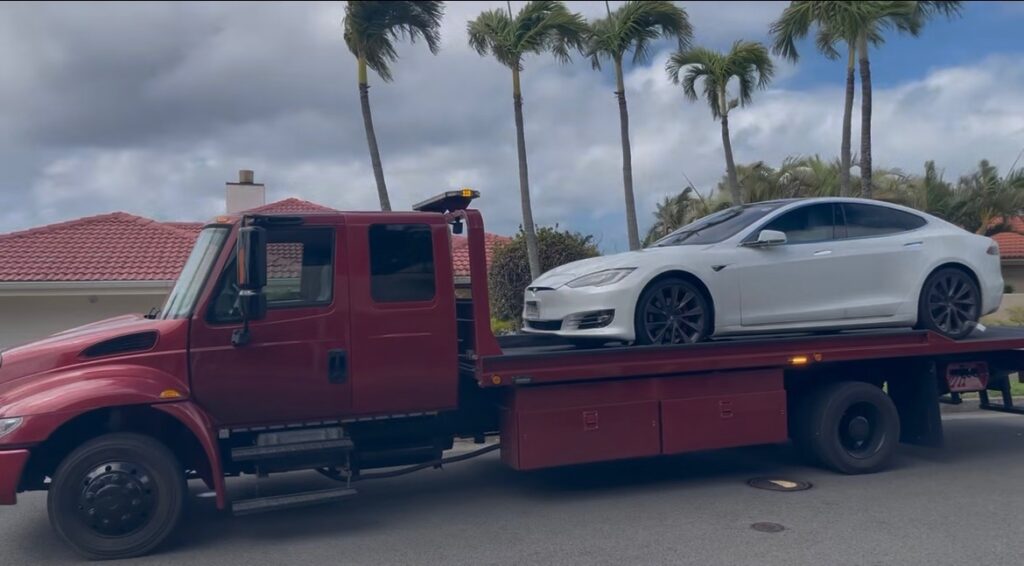
When you need lowered car towing on Oahu, choosing the right towing company matters. A lowered or modified vehicle cannot always be loaded onto a tow truck the same way as a standard-height car.
At Hawaii Towing Company, we have more than 15 years of towing experience on Oahu. Over the years, we have transported lowered vehicles, modified cars, show cars, and vehicles with custom bodywork. One thing we have learned is that safely towing a lowered car starts before the vehicle ever moves.
The front bumper, splitter, side skirts, exhaust, undercarriage, suspension, and rear bumper can all be at risk if the loading angle or connection points are wrong.
Our goal is simple: identify those risks before loading the vehicle and adjust our approach accordingly.
Why Lowered Cars Require a Different Towing Approach
Ground clearance is one of the biggest concerns when towing a lowered vehicle.
As a flatbed tilts toward the ground, the vehicle has to transition from the pavement onto the bed. If that angle is too steep for the vehicle’s clearance, the front bumper or splitter can make contact before the wheels reach the bed.
The rear of the vehicle can also become a problem as the car moves farther onto the flatbed.
This is why towing a lowered vehicle involves more than simply sending a flatbed and pulling the car onto it.
An experienced operator needs to evaluate the vehicle first.
How We Determine Whether a Lowered Car Will Clear the Flatbed
One of the first things we look at is the overall height and ground clearance of the vehicle.
We also pay attention to the setback of the front wheels.
The distance between the front of the vehicle and the front wheels can make a significant difference. A vehicle with a long front overhang and very little clearance may contact the bed sooner than a vehicle whose wheels sit closer to the front bumper.
From experience, we can look at these factors and determine whether the normal flatbed angle is likely to be too steep.
If we believe there is a risk of contact, we do not simply try loading the vehicle to see what happens.
We change the approach.
Specialized Tow Ramps Can Change the Approach Angle
When a lowered vehicle does not have enough clearance for the normal loading angle, we can use specialized tow ramps.
These ramps help change the approach angle between the pavement and flatbed.
That extra clearance can make the difference between safely loading a modified car and scraping an expensive front bumper, splitter, body kit, or undercarriage.
This becomes especially important with vehicles that have:
- Lowered suspension
- Custom body kits
- Front splitters
- Side skirts
- Air suspension
- Low-profile tires
- Modified bumpers
- Very low ground clearance
These modifications do not necessarily mean the vehicle cannot be towed safely. They mean the towing operator needs to recognize the clearance issue and have the proper equipment to handle it.
Where You Connect the Winch Matters
The approach angle is only part of safely towing a lowered car.
Another major concern is the connection point used to pull the vehicle onto the flatbed.
Using the wrong connection point can damage components underneath the vehicle. That is why we look for the appropriate connection before we begin winching.
When available, we prefer to use the vehicle’s tow-eye bolt connection point.
If a suitable tow-eye connection is unavailable, we may use a soft strap around an appropriate control arm or use a soft strap with specialized hooks attached to designated hook points underneath the vehicle.
The exact method depends on the vehicle.
The important part is knowing what you are connecting to before applying force.
Why We Use Soft Straps Around Sensitive Vehicles
When we are dealing with lowered, modified, or show vehicles, protecting the car is a priority during both loading and transportation.
Soft straps give us another option when we need to secure or pull a vehicle without placing unnecessary metal components against sensitive areas.
We carry specialized equipment because not every vehicle gives us the same connection options.
The easiest place to attach a hook is not automatically the correct place.
That is an important distinction when you are dealing with a vehicle that may have expensive suspension, body, or aftermarket components.
A Lowered Show Car Tow That Required Extra Preparation
One job that stands out involved a lowered, modified show car that needed transportation to a car show.
This was not a vehicle where we could simply lower the flatbed and start winching.
Both the front and rear of the car were at risk of scraping.
Before loading it, we recognized that the normal flatbed approach would not provide the clearance we wanted. We used our specialized ramps to improve the loading angle.
We also used a soft strap to pull the vehicle onto the flatbed and specialized soft straps to secure it for transportation.
The car was successfully loaded, transported, and delivered without scraping or damaging the vehicle.
For us, jobs like this demonstrate why preparation matters so much with lowered car towing.
The best time to figure out that a vehicle needs additional clearance is before its bumper touches the flatbed.
Common Mistakes That Can Damage a Lowered Car During Towing
After more than 15 years in the towing industry, there are several mistakes that we would consider particularly concerning when dealing with lowered vehicles.
One is using the wrong connection point when pulling the vehicle onto the truck.
Another is failing to recognize that the normal approach angle is too steep.
Problems can include:
- Scraping the front bumper
- Damaging a front splitter
- Scraping side skirts
- Contacting the exhaust
- Damaging the undercarriage
- Scraping the rear bumper
- Connecting the winch to an improper point
- Using the wrong tie-down equipment
- Attempting to load the vehicle without enough clearance
Many of these problems can be avoided by inspecting the vehicle and planning the loading process before pulling it onto the bed.
Red Flags When Choosing a Towing Company for a Lowered Car
If we owned a lowered or modified vehicle, we would want to know how the towing company planned to transport it before allowing them to start.
One of the first questions we would ask is whether they are bringing a flatbed.
We would also want to know whether they carry the equipment needed for a vehicle with limited ground clearance.
Some red flags we would watch for include:
- The company does not bring a flatbed
- The operator does not have specialized loading ramps
- They do not ask about your vehicle’s modifications
- They do not ask about ground clearance
- They want to connect the winch wherever it is easiest
- They do not have soft straps
- They use inappropriate hooks or chains around sensitive components
- They do not inspect the vehicle before loading it
- They have no plan for protecting a splitter, body kit, or low bumper
If a towing company does not ask questions about a heavily lowered or modified vehicle, that would concern us.
Those details directly affect how the vehicle should be loaded.
What to Tell the Towing Company Before They Arrive
When you call Hawaii Towing Company for lowered car towing on Oahu, we want accurate information about both your vehicle and its location.
Useful information includes:
- Year, make, and model
- How much the vehicle has been lowered
- Whether it has a custom body kit
- Front splitter or lip
- Side skirts
- Air suspension
- Low-profile tires
- Other suspension or body modifications
- Whether the vehicle rolls
- Whether the steering works
- Whether it can shift into neutral
- Whether it has a factory tow-eye location
- Any existing damage
- Exact location of the vehicle
- Parking garage or height restrictions
- Steep hills or driveways
- Tight access around the vehicle
Please tell us about unusual circumstances even if they seem minor.
That information helps us determine whether we have enough access to safely reach the vehicle and whether additional equipment will be required.
Why Accurate Information Before Dispatch Matters
One lesson we have learned over 15+ years is that preparation makes towing safer and more efficient.
If you tell us you have a lowered car with a large front splitter, for example, we can prepare for the possibility that additional ramps will be needed.
Location information is equally important.
A lowered vehicle inside a tight parking garage can present a very different situation from the same vehicle sitting in an open parking lot.
Knowing the situation beforehand allows us to prepare the truck, equipment, and loading plan before we arrive.
It also gives us an opportunity to determine whether we can properly perform the service.
Should Every Lowered Car Be Towed on a Flatbed?
For lowered vehicles, we strongly prefer a flatbed because it gives us greater control over the loading and transportation process.
However, simply requesting a flatbed does not answer every concern.
The operator still needs to consider:
- Approach angle
- Front and rear clearance
- Wheel setback
- Safe winch connection points
- Vehicle modifications
- Tie-down locations
- Access to the disabled vehicle
A flatbed is the equipment. Knowing how to use it around a lowered vehicle is the other half of the equation.
Experience Matters With Lowered and Modified Vehicles
Towing lowered and modified vehicles is a good example of why towing experience matters.
Sometimes the difference between a routine tow and vehicle damage comes down to recognizing that a bumper is going to scrape before it happens.
You need to know when the normal flatbed angle will work and when specialized ramps are necessary. You also need to understand where the vehicle can safely be pulled from and how it should be secured once it is on the truck.
At Hawaii Towing Company, our approach comes from more than 15 years of real towing experience on Oahu.
We would rather take additional time to evaluate a lowered vehicle and set up the equipment correctly than rush the loading process.
Lowered Car Towing Across Oahu
Hawaii Towing Company provides lowered car towing on Oahu for modified cars, show vehicles, lowered daily drivers, and other vehicles requiring additional attention during loading.
If your vehicle has been lowered or modified, tell us when you call.
Let us know about the suspension, body kit, splitter, side skirts, wheels, existing damage, and anything else that affects its ground clearance. We also want to know exactly where the vehicle is located and whether there are access restrictions.
That information allows us to prepare the proper equipment and determine the safest approach before we arrive.
When your vehicle sits only a few inches from the ground, small details matter.
The right flatbed, proper approach angle, correct connection points, specialized ramps, soft straps, and an experienced operator can help protect the vehicle from the moment loading begins until it reaches its destination.